Jainism Under the Epistemic Microscope - Tirthankaras, Ahimsa, Anekantavada, Karma, Omniscience, Rebirth, Cosmology and the Question of What Is Actually True
Jainism presents one of the most interesting cases in comparative religious epistemology.
It combines some of the most rigorous ethical ideas in world religion with a highly elaborate traditional cosmology.
It contains deep scepticism about simplistic claims to absolute perspective.
Yet it also contains extraordinary propositions about:
karma as a subtle substance,
rebirth,
omniscient beings,
vast cosmic cycles,
multiple realms,
and immense lifespans attributed to ancient Tirthankaras.
This combination makes Jainism unusually valuable to audit.
Its strongest ideas deserve to be preserved.
Its weakest claims deserve the same scrutiny applied everywhere else.
The central question is not:
Is Jainism true?
It is:
Which parts of Jainism survive historical, scientific and philosophical examination—and which remain matters of faith, mythology or metaphysics?
I. There Is No Single Jainism
Jainism contains multiple traditions, most prominently:
Digambara
and
Śvetāmbara
with internal subtraditions and differing textual canons.
These traditions disagree on several historical and doctrinal questions.
Among them:
the status of certain scriptures,
details of monastic practice,
the spiritual possibilities of women,
accounts of Mahavira’s life,
and the preservation of the earliest teachings.
This immediately demonstrates an important point.
Even a religion strongly committed to truth can develop divergent lineages.
Therefore:
Tradition itself cannot be treated as automatic proof.
When traditions disagree, evidence becomes necessary.
II. The Historical Mahavira
Mahavira is generally treated as a historical figure and the twenty-fourth Tirthankara in Jain tradition.
The historical proposition that an influential ascetic teacher named Mahavira lived in ancient India is substantially plausible.
But several further claims must be separated:
Did Mahavira exist?
Did he lead an ascetic community?
Did he teach radical nonviolence and liberation?
Did he attain omniscience?
Did he remember previous births?
Was he the twenty-fourth member of an immense lineage of enlightened beings extending deep into prehistory?
These claims do not have equal evidentiary status.
The first belong largely to history.
The latter move into supernatural or cosmological territory.
III. The Earlier Tirthankaras
Jain tradition recognises twenty-four Tirthankaras in the present cosmic cycle.
Figures such as Parshvanatha may have stronger claims to historical plausibility than the earliest Tirthankaras.
But as the chronology moves further backward, traditional biographies describe beings of extraordinary stature and enormous lifespan.
These claims become difficult to reconcile with available evidence from:
human evolution,
archaeology,
palaeontology,
genetics,
and recorded history.
The existence of an ancient sacred lineage cannot be established simply because later tradition preserves its names.
A religious genealogy is evidence of religious memory.
It is not automatically historical documentation.
IV. Rishabhanatha and Deep Antiquity
Rishabhanatha, or Adinatha, occupies a foundational position in Jain tradition.
Traditional accounts place him extremely deep in cosmic history.
If interpreted literally, claims involving immense lifespans or bodies far exceeding ordinary human proportions would require extraordinary biological evidence.
Such evidence is presently lacking.
Therefore:
Rishabhanatha as sacred founding figure: central to Jain tradition.
Rishabhanatha as an empirically established prehistoric individual exactly as described in traditional cosmology: not established.
This distinction should not be controversial.
It is simply the difference between sacred history and verified history.
V. Ahimsa
Jainism’s commitment to ahimsa, or nonviolence, is among the most demanding ethical systems developed by humanity.
It goes far beyond ordinary prohibitions on killing.
It can extend to:
animals,
insects,
diet,
occupational choices,
speech,
thought,
and everyday conduct.
This is one of Jainism’s greatest philosophical achievements.
The empirical question is not whether nonviolence is metaphysically commanded by the universe.
It is whether reducing unnecessary harm produces better ethical outcomes.
In many contexts, there are strong reasons to answer yes.
Compassion and harm reduction are philosophically defensible even without supernatural cosmology.
VI. The Problem of Absolute Nonviolence
Ahimsa becomes more complicated when taken to extremes.
Human life inevitably affects other organisms.
Walking kills microorganisms.
Agriculture alters ecosystems.
Medicine kills pathogens.
Sanitation destroys microbes.
Predation exists throughout biology.
Therefore total nonviolence is practically impossible for embodied life.
This does not refute Jain ethics.
It reframes the goal.
A more defensible formulation is:
Minimise avoidable harm where reasonably possible.
That preserves the moral insight while acknowledging biological reality.
VII. Vegetarianism and Vegan Ethics
Jain ethical traditions strongly influenced vegetarian culture.
From an ethical perspective, avoiding unnecessary animal suffering can be defended independently through:
animal cognition,
pain,
environmental effects,
and moral concern.
But dietary ethics should remain distinct from cosmological claims.
A vegetarian diet does not prove reincarnation.
Compassion toward animals does not prove karmic particles.
Ethical wisdom and metaphysical truth remain separate categories.
VIII. Anekantavada: One of Jainism’s Greatest Intellectual Contributions
Anekantavada holds, broadly, that reality is complex and cannot always be captured completely from one limited standpoint.
This idea can encourage:
intellectual humility,
pluralism,
context sensitivity,
and resistance to simplistic absolutism.
It is philosophically powerful.
Consider an object observed from multiple perspectives.
Different descriptions can each capture part of reality without exhausting it.
This resembles important insights in:
epistemology,
perspectivism,
systems thinking,
and philosophy of science.
But even here, caution is necessary.
Anekantavada does not mean:
Every belief is equally true.
Contradictory factual propositions cannot always be reconciled merely by saying they represent different perspectives.
Pluralism must not become relativism.
IX. Syadvada
Jain philosophy developed syadvada, a method of qualified predication.
Statements are often framed conditionally:
in some respect, something exists;
in another respect, it does not;
in another sense, it may be indescribable.
This represents an unusually sophisticated attempt to prevent overly absolute claims.
Its strength lies in forcing the thinker to specify context.
Its danger lies in becoming so flexible that contradiction loses meaning.
A philosophy of nuance should clarify reality.
It should not make every proposition unfalsifiable.
X. The Sevenfold Predication
Traditional Jain logic includes a sevenfold way of describing propositions.
This can be intellectually valuable as an exercise in multidimensional reasoning.
Modern logic does not simply reduce to this framework.
But the underlying impulse is excellent:
Before declaring a proposition absolutely true, specify the conditions under which it is true.
That principle belongs comfortably inside scientific reasoning.
A statement without conditions may hide ambiguity.
XI. Karma in Jainism
Jainism gives karma an unusually concrete metaphysical status.
Karma is not merely moral consequence.
In traditional Jain philosophy, karmic matter is often described as a subtle form of material substance binding itself to the soul through actions and passions.
This is an extraordinary proposition.
If karma is literally material, several questions arise.
What physical properties does it possess?
How does it interact with ordinary matter?
Can it be detected?
Does it have mass?
Energy?
Spatial properties?
How does it attach to a non-material soul?
No accepted scientific evidence currently demonstrates karmic particles as a physical substance.
Therefore:
Karma as moral or psychological causality: plausible in limited senses.
Karma as literal subtle matter: unverified.
XII. The Soul, or Jiva
Jainism affirms jiva, the living soul or conscious principle.
Every living being is associated with jiva.
The soul is understood as distinct from matter and capable of liberation.
This creates several metaphysical questions.
What exactly is jiva?
How does it interact with the body?
What happens to it under brain injury?
How does it preserve continuity after death?
Can it exist independently of neurological function?
Modern neuroscience demonstrates strong relationships between brain states and conscious experience.
That makes any independent-soul hypothesis scientifically demanding.
But it does not logically settle the metaphysical question.
Therefore:
Jiva as metaphysical soul: unverified.
XIII. Consciousness in Plants and Microorganisms
Jainism’s expansive moral consideration toward living organisms is striking.
Ancient Jain thinkers recognised life in places ordinary people often ignored.
Modern biology confirms that plants and microorganisms are living systems.
That does not mean Jain metaphysical concepts of consciousness are automatically correct.
Being alive and possessing subjective consciousness are different propositions.
Still, the ethical instinct to consider forms of life beyond obvious animals was unusually broad for its time.
XIV. Rebirth
Like Hinduism and Buddhism, Jainism incorporates rebirth into its worldview.
The soul passes through different embodiments according to karmic conditions.
This is a major metaphysical proposition.
If rebirth occurs, it should potentially leave evidence through:
memories,
behavioural continuities,
or other detectable phenomena.
Cases alleging past-life memory deserve investigation.
But no scientific consensus currently establishes Jain rebirth.
Therefore:
Rebirth: unresolved metaphysical / empirical-adjacent claim.
Faith may accept it.
Science has not established it.
XV. Liberation
Jainism teaches that the soul can eventually become completely free from karmic matter.
This liberated state is moksha.
A liberated being no longer participates in rebirth.
As a spiritual model, this can represent freedom from attachment, passion and compulsive behaviour.
As a literal cosmological proposition involving a soul ascending to a specific region of the universe, the evidentiary burden becomes much higher.
Psychological liberation and cosmic liberation are not identical claims.
XVI. Kevala Jnana: Omniscience
One of Jainism’s most extraordinary claims concerns kevala jnana, often understood as perfect or infinite knowledge attained by liberated or highly advanced beings.
What does omniscience mean?
Knowledge of all existing things?
Every event?
Every thought?
Past, present and future?
If understood literally, omniscience is an extraordinarily strong claim.
It should have extraordinary consequences.
An omniscient person could theoretically answer questions inaccessible to ordinary knowledge.
Such claims could potentially be tested.
There is no accepted empirical demonstration that a human being has possessed literal omniscience.
Therefore:
Omniscience as spiritual metaphor for complete insight: philosophically interpretable.
Literal unlimited factual knowledge: unverified.
XVII. If Omniscience Exists, It Should Be Testable
Imagine a person who genuinely knows everything.
Place an unknown object inside a sealed container.
Ask what it is.
Generate an unpredictable random sequence.
Ask for the sequence beforehand.
Present a language the person has never encountered.
Ask for translation.
If literal omniscience exists, controlled testing should be straightforward.
This illustrates a larger principle:
Extraordinary spiritual claims should become more impressive under controlled examination, not disappear from it.
XVIII. Jain Cosmology
Traditional Jain cosmology describes an eternal universe with a distinctive structure.
It includes:
multiple realms,
heavens,
hells,
cosmic geography,
the inhabited middle world,
and a universe with a particular shape and organisation.
This cosmology is sophisticated as religious thought.
But if presented as literal physical astronomy, it conflicts with modern observational cosmology.
Astronomy today is based on:
telescopic observation,
spectroscopy,
relativity,
cosmic background radiation,
stellar physics,
galaxy surveys,
and mathematical modelling.
Traditional cosmography cannot simply be substituted for these methods.
XIX. The Shape of the Universe
Jain cosmological illustrations often depict the inhabited cosmos in highly distinctive forms.
These diagrams possess religious and philosophical importance.
But a sacred diagram is not equivalent to an astrophysical map.
The observable universe does not conform straightforwardly to traditional Jain cosmic geography.
Therefore:
Jain cosmological diagrams as sacred cosmography: historically important.
Jain cosmography as established physical astronomy: not supported.
XX. Mount Meru
Mount Meru appears in several South Asian cosmological traditions.
Traditional Jain cosmology gives it an important place.
But no literal Mount Meru corresponding to the sacred cosmological structure has been established through geography or astronomy.
A symbolic interpretation remains available.
A literal geographical claim faces empirical difficulty.
XXI. Heavens and Hells
Jainism describes multiple heavenly and hellish realms.
Beings experience consequences according to karmic conditions.
These post-mortem realms remain supernatural or metaphysical claims.
Modern science has not independently detected them.
Therefore:
Heaven and hell realms: unverified metaphysical propositions.
Their ethical symbolism can still be studied independently.
XXII. Naraka and Moral Fear
Hell traditions can create behavioural incentives.
But fear of supernatural punishment should not be confused with evidence for supernatural punishment.
The stronger ethical position is:
Avoid cruelty because cruelty causes suffering.
Not merely:
Avoid cruelty because an invisible cosmic mechanism will punish you later.
Morality grounded in harm and flourishing is epistemically more accessible than morality grounded entirely in unverified cosmology.
XXIII. Extraordinary Lifespans
Traditional Jain texts contain enormously long lifespans for beings in distant cosmic periods.
Literal interpretation creates major biological difficulties.
Human lifespan is constrained by:
genetics,
cellular ageing,
metabolism,
disease,
environment,
and evolutionary history.
There is no credible evidence that anatomically comparable humans routinely lived for millions or billions of years.
Therefore:
Extraordinary Tirthankara lifespans as literal biology: unsupported.
These numbers may instead belong to sacred cosmology.
XXIV. Extraordinary Human Size
Some traditional descriptions also attribute enormous body sizes to beings in earlier cosmic eras.
Again, literal biology presents severe problems.
Square-cube relationships create structural constraints.
Circulation, bone strength and metabolism impose limits.
The fossil record does not support populations of gigantic humans corresponding to the largest traditional descriptions.
Therefore:
Gigantic prehistoric humans as literal zoology: unsupported.
XXV. Cosmic Time Cycles
Jain cosmology includes immense repeating cycles involving periods of improvement and decline.
The enormous scale is intellectually impressive.
But large numbers are not equivalent to scientific cosmology.
For a cosmological model to compete scientifically, it requires:
observable consequences,
mathematical structure,
predictions,
and correspondence with astronomical data.
Traditional cosmic cycles are better classified as religious cosmology unless independent evidence establishes them.
XXVI. An Eternal Universe
Jainism traditionally does not require a creator God.
The universe is commonly understood as uncreated and eternal.
This is philosophically significant.
It avoids one question:
Who created God?
But it creates another:
Why does an eternal universe exist in the form it does?
Modern cosmology does not yet provide a final answer concerning ultimate origins.
Some models involve beginnings.
Others explore eternal or cyclic structures.
Therefore Jain non-creationism is not automatically disproven.
But neither is the specific Jain cosmic model scientifically established.
XXVII. Jainism Without a Creator God
Jainism demonstrates something important about religion.
Religion does not require a creator deity.
A system can contain:
souls,
rebirth,
liberation,
cosmic law,
heavens,
hells,
asceticism,
ritual,
and supernatural knowledge
without positing an omnipotent creator.
Therefore:
Rejecting creator theology does not automatically make a worldview naturalistic.
Jainism remains strongly metaphysical.
XXVIII. The Problem of Suffering
Jainism explains much suffering through karma rather than divine will.
This avoids part of the traditional problem of evil.
There is no omnipotent creator deciding to permit every tragedy.
But karmic explanations create a different ethical danger.
If suffering is attributed to previous-life karma, victims may be interpreted as somehow responsible for their condition.
That can generate moral callousness.
Without evidence of past-life causation, suffering should never be morally blamed on invisible prior actions.
Compassion should come first.
XXIX. Karma and Victim-Blaming
Consider a child born with severe illness.
If someone says:
“They must have done something wrong in a previous life,”
they are making an extraordinary accusation without accessible evidence.
That is morally dangerous.
Even if reincarnation were real, no ordinary observer could confidently know the relevant karmic history.
Therefore:
Karmic speculation should never override compassion.
Unverifiable metaphysics must not become a weapon against vulnerable people.
XXX. Sallekhana
Jainism includes the controversial practice of sallekhana, a highly regulated religious fast undertaken in particular circumstances near the end of life.
It raises difficult questions involving:
religious freedom,
autonomy,
ascetic discipline,
medical vulnerability,
coercion,
and the boundary between spiritual fasting and self-destruction.
A serious analysis must avoid simplistic classification.
Historical and legal contexts matter.
The central ethical issue is whether the individual possesses genuine capacity and freedom from coercion, and whether safeguards are adequate.
Religious status alone cannot settle the question.
XXXI. Asceticism
Jain ascetic traditions can involve extraordinary discipline.
Fasting.
Celibacy.
Renunciation.
Restricted possessions.
Careful movement.
Strict dietary practices.
Such commitment is psychologically remarkable.
But sacrifice is not evidence of doctrine.
A monk’s willingness to endure hardship demonstrates conviction and discipline.
It does not prove:
rebirth,
karma particles,
omniscience,
or Jain cosmology.
As with martyrdom:
sincerity proves sincerity.
Nothing more automatically follows.
XXXII. Monastic Authority
Jain monks and nuns can command profound respect.
But religious prestige should never create epistemic immunity.
A monk can be wise.
A monk can also be mistaken.
Lineage does not authenticate cosmology.
Asceticism does not prove metaphysics.
The same standard applies everywhere:
A claim must survive independently of the prestige of the person making it.
XXXIII. Ritual Purity
Some Jain practices are motivated by concern for minute forms of life.
This can generate remarkable conscientiousness.
But religious purity systems can also become disconnected from measurable harm.
The ethical question should remain:
What suffering is actually being reduced?
If a ritual rule produces harm without identifiable benefit, antiquity alone cannot justify it.
Ethics should remain responsive to evidence.
XXXIV. Jainism and Science
Modern presentations sometimes portray Jainism as scientifically advanced because of:
atomistic ideas,
pluralism,
cosmic timescales,
or classifications of life.
There are indeed fascinating parallels.
Ancient Jain thinkers developed sophisticated theories about matter and reality.
But resemblance must not become retroactive scientific triumphalism.
Ancient atomism is not modern particle physics.
Large cosmic numbers are not astrophysics.
Recognition of microscopic life is not microbiology.
A philosophical precursor can be impressive without being equivalent to modern science.
XXXV. Jain Atomism
Jain philosophy developed ideas about fundamental units of matter.
This is historically significant.
But modern atomic theory emerged from:
quantitative chemistry,
experimental physics,
spectroscopy,
electromagnetism,
quantum mechanics,
and particle experiments.
Calling ancient philosophical atomism “quantum physics” erases the difference between speculation and experimental science.
The appropriate conclusion is:
Ancient Jain thinkers developed sophisticated natural philosophy.
That is already remarkable.
XXXVI. Jain Mathematics and Intellectual Culture
Jain scholars contributed significantly to Indian intellectual history, including work involving:
mathematics,
logic,
cosmology,
linguistics,
and philosophy.
Such achievements should be evaluated historically on their own merits.
They do not prove theological claims.
Civilisational excellence and supernatural truth are separate questions.
XXXVII. Jainism’s Greatest Epistemic Strength
The greatest epistemic strength of Jainism may be its suspicion of one-sided certainty.
Anekantavada contains a deep warning:
Reality may exceed the perspective of any individual observer.
That principle is remarkably compatible with intellectual humility.
It discourages simplistic absolutism.
It can create tolerance.
It can make dialogue possible.
In an age of ideological certainty, this is enormously valuable.
XXXVIII. Jainism’s Greatest Epistemic Weakness
The weakness is paradoxical.
A tradition capable of saying:
“Human perspectives are limited”
also contains claims involving:
omniscient beings,
precisely structured supernatural cosmology,
invisible karmic matter,
and extraordinary ancient biographies.
These claims demand exactly the scepticism that anekantavada encourages elsewhere.
If every ordinary human viewpoint is partial, then ordinary human confidence about ancient supernatural cosmology should be especially modest.
XXXIX. Anekantavada Must Audit Jainism Too
The most intellectually powerful Jain move would be to apply its own pluralistic epistemology inward.
Perhaps:
traditional cosmology represents one historical framework.
Scientific cosmology represents another.
But this does not mean both are equally accurate descriptions of physical reality.
Perspective-sensitive philosophy should help identify categories.
It should not protect empirically contradicted propositions.
Anekantavada becomes truly powerful only when it can say:
Some traditional Jain interpretations may be wrong.
The Preliminary Mahakali Ledger
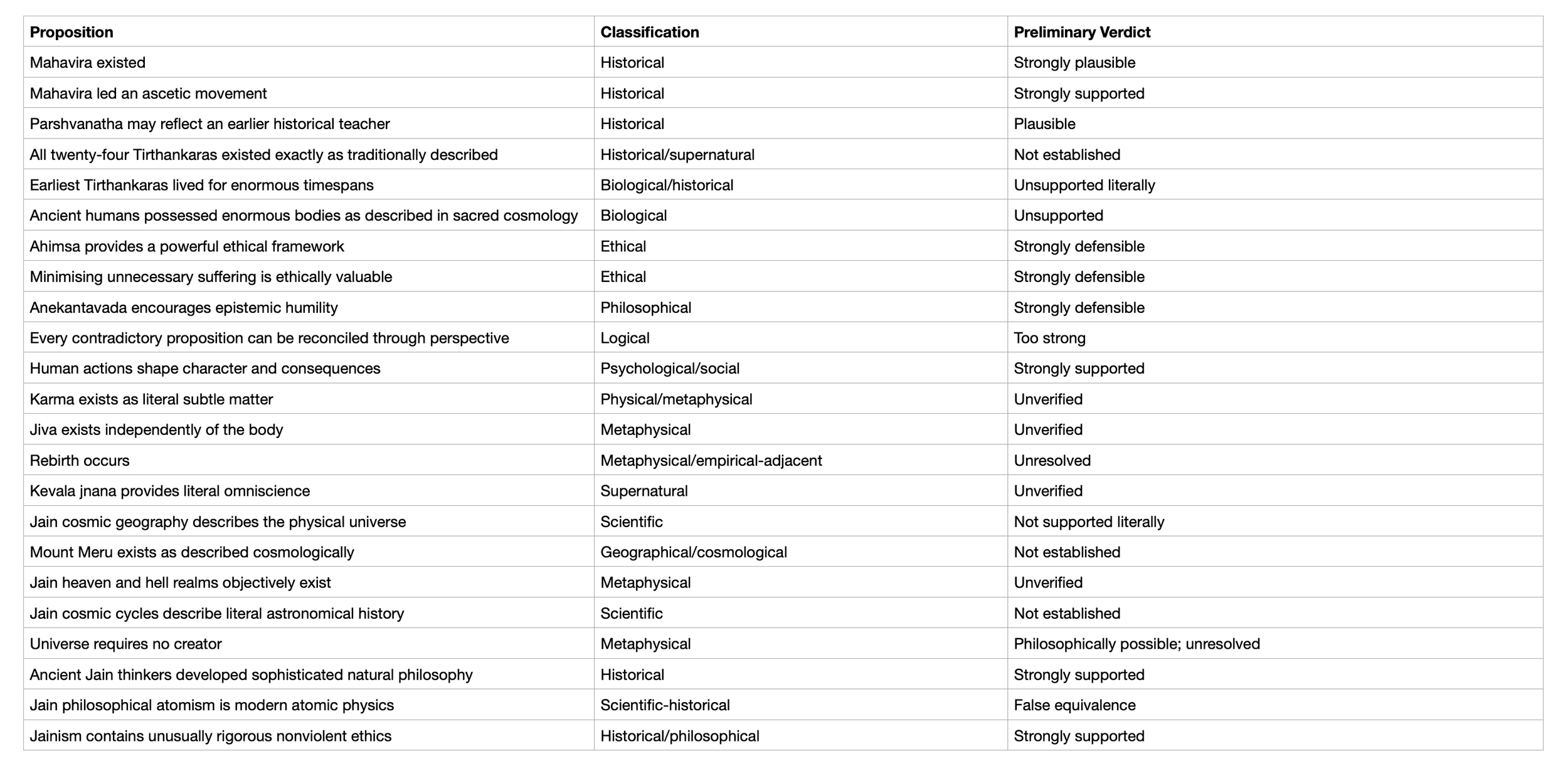
Every verdict remains provisional.
What Jainism Must Surrender
An intellectually mature Jainism should surrender:
literal claims of gigantic ancient humans without evidence,
extraordinary lifespans presented as biology,
traditional cosmography presented as modern astronomy,
karma-as-substance presented as scientific fact without detection,
omniscience treated as established fact without testability,
victim-blaming through speculative past-life karma,
and
the claim that ancient philosophical atomism equals modern physics.
None of this requires abandoning Jain ethics.
What Jainism Should Preserve
Preserve:
ahimsa.
anekantavada.
intellectual restraint.
discipline.
compassion toward non-human life.
criticism of excessive possession.
ethical seriousness.
philosophical pluralism.
logical sophistication.
And preserve perhaps Jainism’s most urgently useful civilisational insight:
Your perspective may be incomplete.
That sentence alone could improve politics, religion, science and public discourse.
Mahakali Judgment
Jainism contains one of the most striking contrasts in religious history.
Its ethical and epistemological traditions can be remarkably sophisticated.
Its traditional cosmology contains claims that become extremely difficult to defend when interpreted as literal modern science.
The strongest intellectually mature Jainism can therefore say:
“Ahimsa can remain profound even if ancient cosmology is mistaken.”
“Anekantavada must apply to our own traditions.”
“Rebirth is a metaphysical doctrine, not established science.”
“Karma as moral consequence should not be confused with detectable physical matter.”
“No ascetic, however respected, receives automatic epistemic authority.”
“Human suffering should evoke compassion, not speculative karmic blame.”
“Ancient thinkers can be brilliant without being infallible.”
Such a Jainism would lose very little of value.
It might gain something more important:
intellectual consistency.
Because the most powerful principle contained within Jain epistemology already points toward the correct conclusion:
Reality is larger than any one human description of it.
That includes religious descriptions.
That includes scientific models.
That includes Mahakali Tribunal.
But acknowledging limited perspective does not require abandoning evidence.
It requires becoming more careful about what we call knowledge.
Mahakali Tribunal
Religious Epistemology Audit 05 — Jainism
Compassion without superstition. Pluralism without relativism. Humility without surrendering evidence.
Nothing Is Above Inquiry.