Sikhism Under the Epistemic Microscope - Guru Nanak, the Gurus, Guru Granth Sahib, Ik Onkar, Revelation, Karma, Rebirth, Miracles, History and the Question of What Is Actually True
Sikhism presents a different epistemic profile from many religions examined so far.
Its central scripture is less concerned with constructing a detailed physical cosmology and more concerned with:
God,
ego,
devotion,
justice,
discipline,
equality,
memory,
music,
moral conduct,
and liberation.
This matters.
A religious tradition that makes fewer specific claims about geology, astronomy, ancient zoology or supernatural technology naturally creates fewer direct collisions with modern science.
But that does not make Sikhism scientifically proven.
It still contains metaphysical propositions concerning:
Ik Onkar,
divine reality,
karma,
rebirth,
mukti,
revelation,
and the spiritual authority of the Gurus.
Those claims deserve the same scrutiny applied everywhere else.
The question is therefore not:
Is Sikhism true?
It is:
Which Sikh claims are historically established, which are philosophically defensible, which belong to faith, and which become doubtful when treated as literal fact?
I. Sikhism Is Historically More Accessible Than Many Ancient Religions
Sikhism emerged in a comparatively recent historical period.
That gives historians significant advantages.
Guru Nanak belongs to the late fifteenth and early sixteenth centuries.
The later Gurus followed across a relatively compact historical period.
The emergence of the Sikh community took place in a world with substantial documentary traditions, political records, identifiable places and relatively accessible chronology.
This does not eliminate uncertainty.
But compared with attempting to reconstruct events thousands of years earlier, the historical foundation is considerably firmer.
The existence of the Sikh Gurus is therefore not remotely comparable to the historicity problems surrounding some prehistoric or deeply mythologised religious figures.
That should count strongly in Sikhism’s favour.
II. Historical Guru Nanak
The proposition that Guru Nanak existed and founded a major religious movement is historically strong.
But several propositions must still be distinguished:
Did Nanak exist?
Did he travel and teach?
Did communities form around him?
Did he compose teachings preserved in Sikh tradition?
Did he experience what he interpreted as divine reality?
Was he divinely commissioned?
Did every miracle later attributed to him occur literally?
The first questions belong principally to history.
The later ones increasingly enter theology and supernatural claims.
As always:
historicity does not automatically establish revelation.
III. The Janamsakhis
Stories concerning Guru Nanak’s life survive in Janamsakhi traditions.
These contain biography, teaching, devotional narrative and miracle stories.
They are culturally and religiously significant.
But historians must ask:
When was each account composed?
Which stories appear earliest?
How much variation exists?
Which episodes have independent support?
Did legendary elaboration occur?
A sacred biography can contain historical memory and later devotional expansion simultaneously.
There is no need to choose between:
“everything happened literally”
and
“everything is fiction.”
Historical criticism exists precisely to separate layers.
IV. Miracle Stories
Traditional accounts sometimes describe extraordinary events involving Guru Nanak and later Gurus.
Miracle claims should receive exactly the same treatment as Christian, Hindu, Buddhist, Jain or Islamic miracle traditions.
The questions remain:
Is there contemporary documentation?
Are there independent witnesses?
Could symbolic storytelling explain the narrative?
Could later religious memory have expanded the event?
What observable evidence exists?
If a miracle allegedly altered the physical world, the evidentiary burden rises accordingly.
Devotional importance does not equal historical verification.
V. Guru Granth Sahib
The Guru Granth Sahib is unusually important in comparative religious analysis because Sikhism ultimately treats scripture itself as Guru.
This gives the text extraordinary authority.
Yet the text is not simply a rulebook or supernatural chronicle.
It consists heavily of:
poetry,
hymns,
devotional theology,
mystical reflection,
ethical instruction,
and spiritual critique.
That genre matters.
A hymn about divine unity is not the same kind of proposition as a claim that a particular mountain physically sits at the centre of the cosmos.
Therefore the Guru Granth Sahib produces comparatively fewer direct clashes with empirical science.
That does not make every metaphysical claim empirically verified.
It means the text often speaks in a category that science is not designed to adjudicate directly.
VI. Textual Preservation
The Sikh scriptural tradition developed with identifiable historical processes of compilation and transmission.
This makes textual history comparatively tractable.
But again, a distinction must remain:
A text can be well preserved.
and:
A text can be divinely authoritative.
The first is historical.
The second is theological.
Perfect preservation would still not prove metaphysical truth.
Preservation proves continuity of a text.
Nothing more follows automatically.
VII. Ik Onkar
At Sikhism’s theological centre stands Ik Onkar: one ultimate reality.
This is one of the tradition’s most profound propositions.
What kind of claim is it?
If Ik Onkar means:
reality is ultimately unified,
that is metaphysical.
If it means:
there exists one personal supernatural deity,
that is theological.
If it means:
the apparent multiplicity of existence rests upon one deeper ontological ground,
that becomes philosophical.
These interpretations can be debated.
But no laboratory experiment has established:
Ik Onkar is objectively true.
Nor has science disproved it.
The appropriate classification is:
Metaphysically meaningful; empirically unverified.
VIII. Sikhism and Monotheism
Sikhism is often classified as monotheistic.
That is broadly useful but incomplete.
The Sikh conception of ultimate reality does not necessarily map neatly onto a simple image of a supernatural monarch sitting outside the universe.
Sikh theology often stresses:
formlessness,
timelessness,
immanence,
transcendence,
unity,
and divine presence throughout existence.
This makes comparison with philosophical theism, panentheism and nondual metaphysics interesting.
But philosophical sophistication does not remove the burden of proof.
A subtle God-concept remains a metaphysical proposition.
IX. Does God Need to Be a Person?
Some religious traditions describe God in strongly anthropomorphic language.
Sikh thought frequently resists this.
Ultimate reality is not reducible to:
male body,
human psychology,
ethnicity,
tribe,
or geographic location.
Epistemically, this avoids many crude supernatural claims.
But it also makes the proposition less directly testable.
The more abstract a concept of God becomes, the harder it becomes both to prove and disprove.
That may make the theology philosophically resilient.
It does not make it scientifically established.
X. Naam
Naam, remembrance of the divine name or reality, occupies a central place in Sikh spirituality.
Practices involving repetition, prayer, music and focused contemplation can clearly produce psychological effects.
They may affect:
attention,
emotion,
stress,
identity,
social bonding,
and subjective meaning.
These can be investigated.
But if Naam is claimed to produce direct supernatural effects, that stronger proposition requires separate evidence.
The effectiveness of devotional practice does not prove the metaphysical object of devotion.
XI. Kirtan
Music is central to Sikh devotional life.
This is important epistemically because music can produce profound alterations in:
emotion,
attention,
memory,
group synchrony,
and subjective transcendence.
A person may experience extraordinary states during kirtan.
That experience is real as experience.
But the interpretation:
“I felt divine presence, therefore God objectively intervened”
requires an additional inference.
This rule should be applied universally.
Sacred music can be transformative without functioning as a laboratory instrument for proving theology.
XII. Hukam
Sikh thought gives great importance to hukam, often translated in terms of divine order, command or cosmic order.
This can be understood in several ways.
As moral submission to reality.
As divine will.
As the structure of existence.
As acceptance of circumstances beyond personal control.
Some interpretations are psychologically defensible.
Others are metaphysical.
A major danger appears when “hukam” is used to explain every event retrospectively.
If success is hukam,
failure is hukam,
tragedy is hukam,
healing is hukam,
war is hukam,
peace is hukam,
then the concept risks explaining everything and predicting nothing.
Religious meaning can remain.
But explanatory power must not be confused with unfalsifiability.
XIII. Karma
Sikhism inherited and transformed ideas of karma within the broader Indian intellectual world.
Again, karma must be separated into levels.
Actions influence character.
Strongly plausible.
Behaviour affects relationships and consequences.
Clearly plausible.
Habits shape future behaviour.
Empirically defensible.
A cosmic moral mechanism determines future births.
Unverified.
The word karma should never be allowed to smuggle the final proposition into the truth of the first three.
XIV. Rebirth
Sikh teachings traditionally incorporate rebirth and liberation from cycles of birth and death.
This raises the same question encountered in Hinduism, Buddhism and Jainism:
Does consciousness survive biological death in a manner capable of entering another life?
At present, science has not established such continuity.
Reports of past-life memory may be investigated.
But Sikh rebirth should currently be classified as:
metaphysical and empirical-adjacent, but unverified.
Faith may affirm it.
Evidence has not established it beyond reasonable doubt.
XV. Mukti
Mukti, liberation, can mean freedom from ego, attachment and rebirth.
There are at least two analytically distinct possibilities.
Psychological liberation:
a profound transformation in how one experiences self, desire and suffering.
Metaphysical liberation:
escape from literal cycles of reincarnation.
The first is potentially investigable through psychology and phenomenology.
The second depends upon first establishing rebirth.
These should not be collapsed.
XVI. Haumai: The Ego Problem
Sikhism’s critique of haumai, roughly ego-centredness or self-importance, is psychologically significant.
Human beings clearly suffer from:
narcissism,
status obsession,
self-deception,
tribal ego,
resentment,
and excessive attachment to identity.
Reducing destructive ego can plausibly improve:
relationships,
judgment,
cooperation,
and emotional stability.
This is one area where Sikh moral psychology can be examined without requiring belief in supernatural cosmology.
The insight can stand on its own merits.
XVII. Equality
Sikhism’s critique of caste hierarchy and emphasis on human equality is among its strongest ethical characteristics.
In principle, Sikh religious identity rejects inherited spiritual superiority based on caste.
Institutions such as langar embody equality through shared food and common space.
This is ethically significant.
But a distinction is necessary between:
what a religion teaches,
and
what its adherents consistently practice.
Caste identities and social stratification have not magically disappeared among Sikh populations.
That demonstrates a universal religious problem:
doctrine can condemn hierarchy while society recreates it.
The failure of followers does not automatically refute the doctrine.
But religious institutions should be judged by how effectively they embody their professed ethics.
XVIII. Langar
The institution of langar is one of Sikhism’s most powerful social technologies.
It operationalises ideas of:
equality,
hospitality,
service,
shared dignity,
and community.
Its value does not require supernatural authentication.
We can ask empirical questions:
Does it reduce hunger?
Does it create social solidarity?
Does it reduce boundaries between groups?
Does it effectively mobilise volunteers?
A religious practice can be justified partly by observable consequences.
Langar is a strong example.
XIX. Seva
Seva, selfless service, is another Sikh principle with clear ethical and social value.
Helping another person does not become valuable only if rebirth exists.
Service can reduce suffering directly.
This gives Sikhism an epistemic advantage in moral practice:
some of its most important virtues do not depend upon speculative metaphysics.
The justification can remain visible in this world.
XX. The Five Ks
The Five Ks function as identity, discipline and collective memory.
Their truth-value is therefore not primarily scientific.
The relevant questions are:
What do they signify?
Do they strengthen community?
Do they impose burdens?
How freely are they adopted?
Do historical reasons continue to matter today?
Cultural practices should generally be evaluated by:
meaning,
effects,
autonomy,
and ethics,
not by asking whether a laboratory has proved them.
This is another case where category discipline matters.
XXI. The Khalsa
The creation of the Khalsa transformed Sikh identity profoundly.
Its development can be studied historically.
It created:
discipline,
collective identity,
military solidarity,
religious commitment,
and institutional resilience.
Theological claims surrounding its divine sanction belong to faith.
Its historical consequences belong to history.
Both can be discussed without confusing the categories.
XXII. Guru Gobind Singh
Guru Gobind Singh is historically much more accessible than legendary founders situated in remote antiquity.
His political, literary and military context can be investigated.
But later devotional narratives surrounding him may still include supernatural elements.
Once again:
historical greatness does not require supernatural exaggeration.
A person can be extraordinary without violating physics.
XXIII. Scripture as Guru
After the human Gurus, Sikh tradition recognises the Guru Granth Sahib as the eternal Guru.
This creates a unique epistemic issue.
A text can function socially and spiritually as ultimate authority.
But can a text itself be wrong?
If the answer is:
“No interpretation of this scripture can ever be mistaken,”
the usual problem of infallibility reappears.
If instead the claim is:
“The scripture is spiritually authoritative, while human interpretations remain fallible,”
the tradition gains considerably more epistemic flexibility.
This distinction matters enormously.
XXIV. Can Poetry Be Infallible?
Religious poetry frequently communicates through:
paradox,
metaphor,
symbol,
emotion,
analogy,
and mystical language.
Demanding literal scientific precision from poetry can itself be a mistake.
But declaring every poetic expression metaphysically infallible creates the opposite problem.
The correct approach is to identify genre before assigning truth conditions.
A hymn about divine unity should not be treated like a physics equation.
Nor should metaphorical ambiguity be exploited to claim scientific prediction after the fact.
XXV. Sikhism and Science
Sikh scripture contains comparatively fewer claims that directly compete with modern scientific theories.
This is significant.
It means there is less pressure to construct apologetics claiming:
Guru Nanak discovered quantum mechanics,
Sikh scripture predicted cosmology,
or hymns secretly encode modern astrophysics.
Such claims occasionally appear in religious apologetics generally and should be resisted.
A spiritual text does not become more valuable by being falsely marketed as a science textbook.
XXVI. Cosmology
Sikh scripture refers poetically to the vastness of creation and innumerable worlds.
Such passages can sound strikingly compatible with modern astronomical vastness.
But caution is required.
Broad statements about countless worlds are not equivalent to:
mathematical cosmology,
planetary science,
galaxy surveys,
or exoplanet detection.
Compatibility is not prediction.
A religious text can express awe at cosmic immensity without thereby discovering modern astrophysics.
XXVII. “Many Worlds” Is Not Modern Astronomy
If an ancient text says creation is vast or contains many worlds, that may be philosophically impressive.
But for a scientific prediction, one would want:
specific mechanisms,
testable predictions,
quantitative models,
and information unavailable through ordinary reasoning.
Otherwise we should classify the statement as cosmological imagination or theological poetry.
There is no need to inflate it.
XXVIII. Miracles at Gurdwaras
Popular religious cultures often generate miracle stories around sacred places.
Healing.
visions.
answered prayers.
protective intervention.
unexpected events.
These deserve respectful documentation.
But not automatic supernatural interpretation.
The relevant alternatives include:
coincidence,
psychological effects,
spontaneous medical change,
selective reporting,
memory distortion,
and ordinary causal explanations.
A miracle claim should become stronger when investigated rigorously.
XXIX. Ardas and Prayer
Prayer can produce:
hope,
discipline,
attention,
emotional regulation,
community,
and meaning.
These effects are compatible with psychological study.
The stronger proposition is:
Waheguru intervenes physically because a specific prayer was offered.
That requires evidence beyond subjective conviction.
Otherwise success and failure can both be attributed to divine will, making the claim difficult to falsify.
Prayer can retain religious value without overstating empirical proof.
XXX. Martyrdom
Sikh history contains extraordinary stories of martyrdom and resistance.
These events profoundly shaped Sikh identity.
But as discussed in previous audits:
willingness to die demonstrates conviction, not metaphysical truth.
A person may courageously die for something they sincerely believe.
That establishes extraordinary commitment.
It does not scientifically verify theology.
This distinction does not diminish the moral courage involved.
XXXI. Sikhism and Violence
Sikhism strongly values justice and protection of the oppressed.
It also developed a martial tradition under conditions of persecution and political conflict.
This creates an important ethical distinction:
violence for domination,
and force used in defence.
Religious rhetoric should never make either category immune from scrutiny.
Claims of righteous violence must be assessed according to:
necessity,
proportionality,
discrimination,
last resort,
and protection of civilians.
A sacred justification cannot automatically turn violence into justice.
XXXII. Sant-Sipahi
The Sikh ideal of the saint-soldier attempts to combine spiritual discipline with the capacity to resist oppression.
Philosophically, this is interesting because it rejects both:
passive spirituality,
and uncontrolled militarism.
Its quality depends on maintaining the balance.
Without “saint,” the soldier can become violent.
Without the capacity to defend, moral ideals can become powerless before brutality.
The concept can be ethically defensible without requiring supernatural proof.
XXXIII. Caste: Doctrine Versus Practice
Sikh theology offers strong resources against caste hierarchy.
Yet caste labels and marriage patterns still exist among Sikh communities.
This gap should be confronted rather than hidden.
It does not prove Sikh teachings false.
It demonstrates that cultural conditioning can survive religious reform.
A tradition claiming equality should measure itself by real social outcomes.
In that sense, social statistics can become part of religious self-audit.
XXXIV. Gender
Sikh scripture and tradition contain powerful affirmations of human dignity that have frequently been interpreted as supportive of gender equality.
Yet Sikh institutions, like most historical religious communities, have existed within patriarchal societies.
The epistemic and moral question is therefore:
Should historical custom override principles of equality?
No tradition should use “this is how it has always been done” as the final argument.
Ethical principles should be applied consistently.
XXXV. Superstition
Guru Nanak and Sikh teaching are often associated with criticism of empty ritual, caste pride, religious hypocrisy and superstition.
This gives Sikhism an internal tool for epistemic reform.
But no community is immune from recreating superstition.
Sacred objects can become magical objects.
Stories can become unquestionable.
Religious leaders can become excessively revered.
Ritual can return under different names.
Therefore criticism of superstition must remain continuous.
XXXVI. Astrology and Ritual Fatalism
Where Sikh communities adopt astrology, horoscope matching or deterministic ritual beliefs from surrounding culture, an important question arises:
Are these actually consistent with Sikh theological principles?
More importantly for this audit:
Do they work?
Astrology should face empirical testing regardless of whether practiced by Hindus, Sikhs or anyone else.
Cultural borrowing does not create scientific validity.
XXXVII. Deras and Religious Authority
Some Sikh environments include powerful sectarian leaders, deras and charismatic figures.
These institutions vary enormously.
But any charismatic leader claiming:
special revelation,
miracle powers,
divine status,
exclusive salvation,
or unquestionable authority
should face immediate scrutiny.
The same rule applies across religions:
Charisma is not evidence.
A religious community built partly around critique of priestly monopoly should be especially alert to recreating new forms of spiritual hierarchy.
XXXVIII. Can the Guru Be Questioned?
This is perhaps the hardest internal question.
A religion becomes epistemically strong when adherents can ask:
What does this passage mean?
Could our interpretation be mistaken?
What historical context produced this practice?
What evidence supports this claim?
Does this tradition remain morally defensible?
Questions are not disrespect.
Questions are the means by which inherited ideas are prevented from becoming intellectual fossils.
If a teaching is true, careful inquiry should deepen rather than destroy it.
XXXIX. Sikhism’s Greatest Epistemic Strength
Sikhism’s greatest epistemic strength may be that many of its central teachings are not claims about obscure ancient physics.
They concern:
ego,
service,
equality,
justice,
remembrance,
compassion,
courage,
discipline,
and relationship to ultimate reality.
The ethical components can often be assessed through human consequences.
The metaphysical components can remain explicitly metaphysical.
That separation allows Sikhism to avoid many unnecessary conflicts with science.
XL. Sikhism’s Greatest Epistemic Weakness
The weakness appears when reverence becomes immunity.
If scripture cannot be questioned,
if traditional interpretation cannot be reconsidered,
if miracle stories cannot be historically examined,
if cultural practices become sacred merely through repetition,
then the same epistemic enclosure found elsewhere can emerge.
Sikhism’s comparatively restrained supernatural cosmology does not make it immune to authoritarian certainty.
No religion is immune.
XLI. Sikhism Does Not Need Fake Science
Sikhism has little to gain by claiming that the Guru Granth Sahib secretly predicted:
the Big Bang,
quantum physics,
multiverse theory,
modern psychology,
or astrophysics.
If a passage expresses cosmic vastness, let it express cosmic vastness.
If a hymn describes unity, examine its philosophy.
If a teaching encourages compassion, evaluate its ethics.
Turning poetry into counterfeit science weakens rather than strengthens religious literature.
A great poem does not become greater by pretending to be a laboratory paper.
The Preliminary Mahakali Ledger
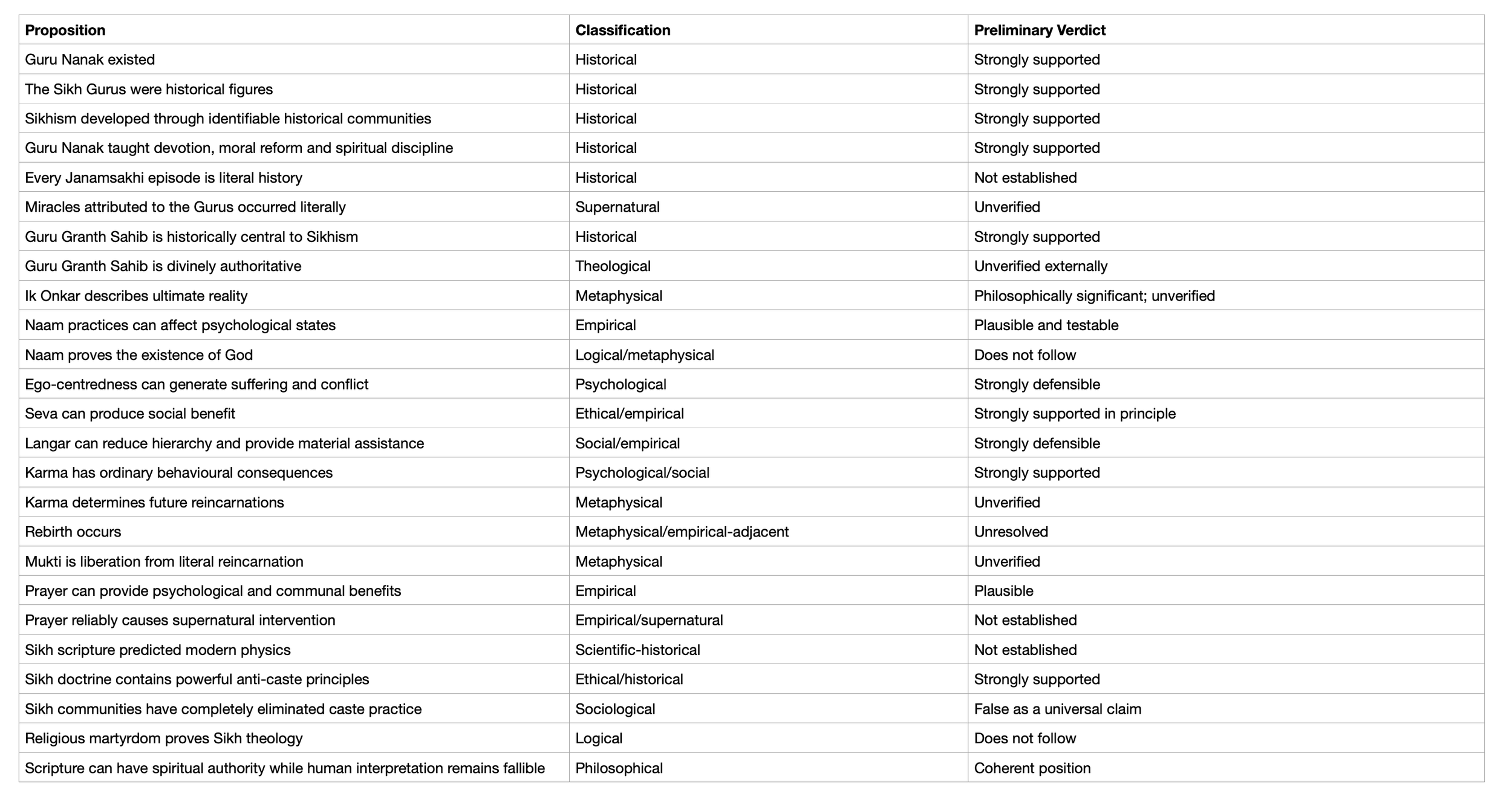
Every verdict remains open to better evidence.
What Sikhism Should Surrender
An intellectually mature Sikh tradition should have no difficulty surrendering:
literal certainty around poorly corroborated miracle stories,
attempts to transform devotional poetry into modern scientific prediction,
astrology and superstition presented as knowledge,
the immunity of charismatic religious leaders from scrutiny,
caste practices that contradict professed equality,
the assumption that reverence requires historical credulity,
and
the claim that questioning interpretation amounts to questioning human dignity.
None of these are necessary for Sikhism’s strongest ideas to survive.
What Sikhism Should Preserve
Preserve:
Ik Onkar as a serious metaphysical proposition.
Naam as contemplative practice.
Seva.
Langar.
the rejection of inherited spiritual superiority.
the critique of ego.
the union of contemplation with action.
the defence of oppressed people.
the poetry.
the music.
the historical memory of resistance.
the refusal to reduce spirituality to ritual performance.
And preserve an idea that deserves universal application:
Human status does not determine human worth.
That principle survives an epistemic audit remarkably well.
Mahakali Judgment
Among the religions examined so far, Sikhism presents relatively few direct conflicts with established natural science because its primary scripture is largely devotional, philosophical, ethical and mystical rather than a detailed manual of physical cosmology.
That is an epistemic advantage.
But it should not be exaggerated.
Sikhism still contains unverified claims concerning:
ultimate divine reality,
revelation,
karma,
rebirth,
liberation,
and supernatural events.
Those propositions do not become scientific facts through devotion.
The strongest intellectually mature Sikhism can therefore say:
“Guru Nanak was historically real; divine revelation remains a matter of faith.”
“The Guru Granth Sahib is sacred to us; that does not turn poetry into astrophysics.”
“Miracle stories may inspire us without requiring historical certainty.”
“Seva is valuable because suffering is real here and now.”
“Caste contradicts our ethical ideals even when Sikhs continue to practice it socially.”
“My religious experience can transform me without compelling another person to accept my metaphysical explanation.”
“Rebirth is a religious proposition, not established science.”
“Religious authority must never become immunity from questioning.”
Such a Sikhism would lose remarkably little.
It might instead reveal why some of its strongest ideas remain powerful even outside theological certainty.
A religion does not become intellectually mature by proving that every inherited story happened.
It becomes mature when it can distinguish:
history from devotion,
metaphysics from science,
culture from truth,
and spiritual conviction from public evidence.
That is a distinction Sikh thought may be unusually well positioned to make.
Mahakali Tribunal
Religious Epistemology Audit 06 — Sikhism
Reverence without credulity. Courage without dogma. Service without superstition.
Nothing Is Above Inquiry.