Buddhism Under the Epistemic Microscope - Historical Buddha, Four Noble Truths, Meditation, No-Self, Karma, Rebirth, Nirvana, Devas and the Claim That Buddhism Is “Scientific”
Buddhism is often presented in modern discourse as the religion most compatible with science.
Sometimes it is described as not really a religion at all.
That is misleading.
Buddhist traditions contain empirical practices, philosophical arguments, ethical systems, monastic institutions, metaphysics, cosmology, supernatural beings, rebirth doctrines, miracle traditions and devotional practices.
Some Buddhist claims are unusually open to investigation.
Others are no more scientifically established than supernatural claims in other religions.
The correct question is therefore not:
“Is Buddhism scientific?”
It is:
Which Buddhist claims are empirically supported, which are philosophical, and which remain religious metaphysics?
That distinction changes everything.
I. There Is No Single Buddhism
Buddhism includes multiple textual and institutional traditions.
Among them:
Theravada.
Mahayana.
Vajrayana.
Zen.
Pure Land.
Tibetan Buddhism.
Nichiren traditions.
Chan.
Seon.
Various regional and folk traditions.
Their scriptures, philosophies and devotional practices differ.
The Pali Canon is not identical to the Mahayana sutras.
Mahayana sutras are not identical to Tibetan tantric literature.
Zen rhetoric differs from Pure Land devotion.
Therefore:
“Buddhism teaches…” requires qualification.
Which Buddhism?
Which period?
Which school?
Which scripture?
Which interpretation?
II. The Historical Buddha
The existence of Siddhartha Gautama as the historical figure behind Buddhism is broadly plausible and widely accepted.
But again, several propositions must be separated:
Did a teacher called Gautama Buddha exist?
Did he lead a renunciant community?
Did he teach doctrines concerning suffering, liberation and meditation?
Did he remember countless previous lives?
Did supernatural beings visit him?
Did he possess extraordinary abilities?
Did he attain a metaphysical state called nirvana?
The first group belongs largely to history.
The latter claims move into metaphysics and supernatural tradition.
Historicity does not automatically authenticate supernatural biography.
III. How Much Do We Know About the Historical Buddha?
The surviving Buddhist scriptures were transmitted through communities after the Buddha’s lifetime.
This creates familiar historical questions:
How early are particular teachings?
How accurately were they preserved?
Which sayings are likely early?
Which reflect later doctrinal development?
How much oral transmission occurred?
How much sectarian evolution occurred?
Buddhist traditions developed sophisticated preservation systems.
But preservation does not remove the ordinary problems of ancient historiography.
The Buddha recorded in scripture is simultaneously:
a probable historical teacher,
and a religious figure shaped by generations of memory and theology.
IV. The Four Noble Truths
At the centre of early Buddhism lies a diagnosis:
suffering or dissatisfaction exists,
craving contributes to it,
cessation is possible,
and a path can reduce or end it.
Unlike many religious claims, parts of this framework are empirically approachable.
Does craving generate distress?
Often, yes.
Can compulsive attachment increase suffering?
Clearly.
Can attention, behaviour and cognition change suffering?
Yes.
Can meditation and ethical practice alter mental states?
Yes.
But these observations do not automatically establish every Buddhist metaphysical conclusion.
There is a large difference between:
“craving frequently contributes to suffering”
and:
“the Buddhist account of liberation across rebirth is therefore cosmologically true.”
The first can be studied.
The second requires additional evidence.
V. Buddhism’s Greatest Empirical Advantage: Practice Produces Observable Effects
Meditation is one reason Buddhism has attracted serious scientific interest.
Practices involving:
attention,
breathing,
compassion,
body awareness,
metacognition,
and emotional regulation
can generate measurable psychological and physiological effects.
Research has investigated potential relationships with:
stress,
attention,
emotion regulation,
pain,
well-being,
and cognitive processes.
This is genuinely interesting.
But an essential logical boundary must remain:
Meditation working does not prove Buddhism.
If a Buddhist breathing technique improves attention, that demonstrates an effect of the technique.
It does not prove:
rebirth,
karma across lives,
devas,
hell realms,
or nirvana as a post-mortem metaphysical reality.
Effective technology and correct cosmology are separate questions.
VI. “Buddhism Predicted Neuroscience”
Modern Buddhist apologetics sometimes claims that Buddhism anticipated modern neuroscience.
There is some legitimate overlap.
Buddhist thinkers developed sophisticated introspective models concerning:
attention,
habit,
perception,
desire,
identity,
impermanence,
and the constructed nature of experience.
These are intellectually impressive.
But introspective sophistication is not equivalent to experimental neuroscience.
Ancient Buddhists did not possess:
neuronal theory,
electrophysiology,
brain imaging,
molecular neuroscience,
modern cognitive science,
or contemporary neuroanatomy.
A more defensible claim is:
Some Buddhist psychological observations remain interesting in light of modern cognitive science.
That is impressive enough.
There is no need to inflate it into ancient neuroscience.
VII. No-Self: Did Buddhism Discover That the Self Is an Illusion?
The doctrine of anatta or non-self is one of Buddhism’s most philosophically provocative ideas.
Modern neuroscience provides reasons to question the idea of a simple, indivisible inner controller.
Human identity appears to depend upon interacting processes involving:
memory,
perception,
emotion,
attention,
body representation,
language,
and social cognition.
In this limited sense, some Buddhist analysis resonates strongly with contemporary ideas.
But “there is no permanent independent self” can mean several different things.
Psychological self-construction?
Philosophical denial of an eternal soul?
Moment-to-moment impermanence?
Absolute metaphysical nonexistence of any enduring subject?
These are not identical.
Neuroscience may support some weaker claims about constructed identity.
It does not automatically prove every metaphysical interpretation of anatta.
VIII. Impermanence
The Buddhist emphasis on impermanence is among its strongest observations.
Organisms change.
Thoughts change.
Relationships change.
Bodies age.
Civilisations rise and fall.
Mental states appear and disappear.
At ordinary empirical levels:
impermanence is overwhelmingly observable.
But again, philosophical consequences must be argued separately.
The fact that many phenomena change does not by itself establish the complete Buddhist account of reality.
Still, compared with many ancient cosmological propositions, impermanence has remarkable observational durability.
IX. Dukkha
The Buddhist concept of dukkha is frequently translated as suffering, although dissatisfaction or unsatisfactoriness may capture part of its broader meaning.
Is life characterised by dukkha?
This cannot be treated as a simple scientific proposition because it contains philosophical interpretation.
Yet psychological evidence strongly supports the idea that:
humans adapt to pleasure,
desire repeatedly renews itself,
loss is unavoidable,
uncertainty generates anxiety,
and attachment can amplify distress.
This gives Buddhist analysis considerable psychological credibility.
But the universal scope of dukkha remains philosophical rather than purely experimental.
X. Craving
Buddhist analysis of craving may be one of its most empirically fertile ideas.
Modern psychology recognises processes resembling:
compulsion,
reward seeking,
addiction,
hedonic adaptation,
rumination,
and reinforcement.
The Buddhist claim that compulsive craving can produce suffering therefore has substantial intuitive and empirical support.
The stronger claim that eliminating craving produces final liberation from the entire cycle of rebirth remains another matter.
XI. Nirvana
What is nirvana?
The answer varies across Buddhist traditions and interpretations.
Possibilities include:
cessation of craving,
liberation from ignorance,
freedom from rebirth,
an unconditioned state,
a radical transformation of consciousness,
or something difficult to express conceptually.
Some psychological aspects may be investigated.
But if nirvana includes metaphysical liberation from samsara across lives, science currently cannot establish that claim.
Therefore:
Nirvana as transformative psychological condition: potentially investigable.
Nirvana as final metaphysical liberation from rebirth: unverified.
XII. Karma Again
Buddhist karma should not be reduced to “the universe punishes bad people.”
In many Buddhist traditions, karma concerns intentional action and its consequences.
At an ordinary level:
intentions shape habits.
habits shape behaviour.
behaviour shapes character.
behaviour affects social outcomes.
These are plausible.
But traditional Buddhism usually extends karma beyond one lifetime.
That turns karma into a much larger cosmological mechanism.
There is currently no accepted scientific demonstration of moral causality operating across reincarnations.
Therefore:
psychological karma: highly plausible.
cross-lifetime karmic causation: unverified.
XIII. Rebirth
Buddhism faces a particularly interesting puzzle here.
Many traditions deny a permanent self while affirming rebirth.
What exactly continues?
Different schools offer sophisticated answers involving causal continuity rather than an eternal soul.
Philosophically, this is fascinating.
Empirically, the question remains:
Does some meaningful stream of consciousness or causal identity continue after biological death?
Reports of past-life memories and unusual cases deserve investigation.
But current evidence does not justify treating rebirth as established scientific fact.
The appropriate verdict remains:
Open research question; insufficient evidence for certainty.
XIV. Past-Life Memories
Children reporting apparently verifiable previous lives are among the most interesting empirical claims associated with rebirth.
Such cases should neither be ridiculed nor treated as proof without examination.
Investigators must consider:
information leakage,
family influence,
cultural conditioning,
coincidence,
memory contamination,
selective case reporting,
fraud,
and statistical reasoning.
If cases survive increasingly strict controls, they become more interesting.
Science should investigate unusual data.
But unusual data should not receive reduced methodological standards simply because it supports a cherished doctrine.
XV. Buddhist Cosmology
Traditional Buddhist literature describes elaborate cosmologies involving:
multiple realms,
heavens,
hells,
devas,
hungry ghosts,
various classes of beings,
vast cosmic cycles,
and rebirth across different forms of existence.
These ideas are often omitted when Buddhism is marketed to modern secular audiences.
But historically they matter.
If interpreted literally as a physical or supernatural map of reality, they require evidence.
Modern astronomy has not independently confirmed Mount Meru cosmology or traditional Buddhist world systems as descriptions of physical cosmic geography.
Treating them symbolically or mythologically avoids that conflict.
Calling them ancient astrophysics does not.
XVI. Devas
Buddhist traditions include devas and other supernatural beings.
This creates an interesting comparison with supposedly “theistic” religions.
Buddhism may reject an eternal creator God while still containing a populous supernatural universe.
Therefore:
non-theistic does not mean non-supernatural.
The existence of devas remains unverified.
Reports of encounters establish human experiences or traditions.
They do not independently establish supernatural ontology.
XVII. Hell Realms
Some Buddhist traditions describe terrifying hell realms produced by karma.
These may be interpreted:
literally,
psychologically,
symbolically,
or cosmologically.
A literal post-mortem hell is an extraordinary supernatural claim.
It remains empirically unverified.
A psychological interpretation—states of extreme hatred, terror or suffering resembling “hell”—is much easier to defend.
Again, interpretive level matters.
XVIII. Hungry Ghosts
The hungry ghost is one of Buddhism’s most psychologically powerful symbols.
A being with enormous appetite and almost no capacity for satisfaction is an extraordinary metaphor for addiction and compulsive desire.
That symbolism is psychologically intelligible.
Whether hungry ghosts objectively exist as non-human beings is a separate supernatural proposition.
The metaphor does not prove the entity.
XIX. Buddhist Miracles
Traditional Buddhist literature attributes extraordinary abilities to enlightened practitioners.
These can include:
telepathy,
levitation,
clairvoyance,
past-life recollection,
supernatural perception,
and other siddhis.
If such abilities objectively occur, they should produce testable effects.
Controlled demonstrations would revolutionise science.
Until such evidence exists, these claims remain unverified.
The fact that a tradition discourages obsession with powers does not constitute evidence that the powers exist.
XX. The Buddha’s Miracles
Later Buddhist biographies often elevate the Buddha far beyond an ordinary philosophical teacher.
Miraculous births.
Supernatural signs.
Cosmic events.
Extraordinary abilities.
Interactions with gods.
These may have devotional significance.
But the historical Buddha becomes harder to identify as theological elaboration accumulates.
This is a pattern seen across religions:
successful teacher,
community memory,
sacred biography,
supernatural expansion.
Recognising the pattern does not prove every miracle false.
It should reduce automatic certainty.
XXI. Mahayana Sutras
Mahayana Buddhism introduces a major historical question.
Many Mahayana sutras appear later in the historical record than the earliest Buddhist textual strata.
Yet they are often presented within tradition as profound teachings associated with the Buddha or transcendent revelation.
How should this be evaluated?
Historically, later appearance matters.
Theologically, traditions may argue that teachings were preserved in hidden or supernatural ways until humanity was ready.
But that explanation itself is a supernatural claim.
A historian cannot assume it merely because the scripture says so.
Therefore:
Mahayana sutras as major Buddhist religious literature: unquestionable.
Direct historical speech of the historical Buddha: requires text-specific evidence and often remains doubtful.
XXII. Bodhisattvas
Mahayana Buddhism contains elaborate devotion to bodhisattvas such as Avalokiteshvara and Manjushri.
Several interpretations are possible.
Historical-symbolic ideal?
Archetype?
Object of devotional contemplation?
Actual transcendent being capable of intervention?
Only the last proposition creates a strong external evidentiary burden.
Devotional usefulness does not automatically establish supernatural existence.
XXIII. Pure Land Buddhism
Pure Land traditions involve devotion to Amitabha Buddha and rebirth in a Pure Land.
This is unmistakably religious.
The idea that Buddhism contains no faith resembles Buddhism poorly.
Pure Land practice can involve enormous trust in transcendent assistance.
That is structurally comparable in some respects to devotional religion elsewhere.
Again:
religious meaning: real.
literal post-mortem Pure Land: metaphysical claim, unverified.
XXIV. Vajrayana
Vajrayana traditions add further layers:
tantric deities,
mandalas,
mantras,
initiations,
subtle-body systems,
visualisation,
ritual technologies,
esoteric teachings,
and advanced meditation.
Some practices may produce powerful psychological effects.
Some may encode sophisticated phenomenology.
But claims about literal supernatural beings, magical effects or invisible energies require independent evidence.
Esoteric status should increase scrutiny, not decrease it.
XXV. Tibetan Reincarnate Lamas
The identification of reincarnated teachers creates a rare case where metaphysical claims affect institutional succession.
The epistemic questions are obvious:
How are candidates identified?
What prior information is available?
Are tests blinded?
Could families or institutions influence the process?
How many unsuccessful candidates exist?
What would falsify the reincarnation hypothesis?
A process involving political and religious authority should be examined especially carefully.
Faith-based succession and demonstrated reincarnation are not the same thing.
XXVI. Meditation and Adverse Effects
The modern wellness industry often presents meditation as universally beneficial.
That is too simple.
Intensive meditation can sometimes be associated with difficult experiences such as:
anxiety,
dissociation-like experiences,
sleep disruption,
distressing perceptual changes,
or emotional destabilisation.
This does not make meditation dangerous in general.
It means contemplative technologies affect minds and should be treated with the seriousness given to other powerful psychological interventions.
“Ancient” does not mean automatically harmless.
XXVII. Monastic Authority
Buddhist monks are often idealised in secular Western culture.
But robes do not guarantee wisdom.
Monastic institutions are human institutions.
They can contain:
scholarship,
discipline,
compassion,
hierarchy,
politics,
abuse,
dogma,
and institutional self-protection.
The same rule applied to priests, gurus and clerics applies here:
Spiritual status is not epistemic evidence.
Claims must stand independently of authority.
XXVIII. Buddhism and Violence
The stereotype that Buddhism is inherently incapable of violence is historically naïve.
Buddhist-majority societies and Buddhist institutions have participated at times in:
nationalism,
warfare,
ethnic conflict,
political repression,
and religious exclusion.
This does not prove Buddhist philosophy violent.
It demonstrates that:
beautiful teachings do not automatically produce beautiful institutions.
The behaviour of followers and the truth of doctrine must be analysed separately.
XXIX. Is Buddhism a Philosophy Rather Than a Religion?
It can function as both.
A secular practitioner may use Buddhist meditation and philosophy without believing in:
rebirth,
devas,
karma across lives,
cosmic realms,
or devotional supernaturalism.
That is a legitimate modern adaptation.
But describing historical Buddhism entirely as secular philosophy erases enormous portions of actual Buddhist tradition.
Buddhism contains:
scripture,
ritual,
monasticism,
devotion,
cosmology,
relics,
pilgrimage,
supernatural entities,
and theories of post-mortem existence.
By ordinary comparative standards, that qualifies comfortably as religion.
XXX. Is Buddhism Compatible With Science?
In some respects, unusually so.
Buddhist traditions often emphasise:
observation,
introspection,
impermanence,
causality,
mental training,
and suspicion toward simplistic permanent identity.
These can interact productively with science.
But compatibility has limits.
Traditional Buddhist cosmology, rebirth, karma across lives, devas and supernatural powers are not established scientific propositions.
Therefore:
Buddhism is partially science-compatible, not scientifically proven.
That distinction is essential.
XXXI. The Kalama Sutta Problem
Modern Buddhist discourse frequently invokes teachings encouraging people not to believe claims merely because of:
tradition,
scripture,
hearsay,
or authority.
This is one of Buddhism’s most attractive epistemic motifs.
But it should be applied consistently.
If experience and investigation matter, then:
rebirth must also be investigated.
karma must be investigated.
miracle claims must be investigated.
monastic authority must be investigated.
Buddhist scripture itself must be investigated.
A principle encouraging inquiry should not become merely an advertisement for conclusions already accepted in advance.
XXXII. Buddhism’s Greatest Epistemic Strength
Buddhism’s greatest strength may be methodological rather than theological.
It encourages some practitioners to observe the mind directly.
Watch craving arise.
Watch anger arise.
Watch thoughts disappear.
Observe attachment.
Notice impermanence.
Examine identity.
Develop attention.
That creates something resembling a laboratory of subjective experience.
It is not modern experimental science.
But it represents an unusually systematic introspective tradition.
This deserves serious respect.
XXXIII. Buddhism’s Greatest Epistemic Weakness
The weakness appears when useful psychological observations are used to validate unrelated metaphysics.
Meditation works.
Therefore rebirth is true.
Mindfulness helps.
Therefore karma operates between lifetimes.
No-self resonates with neuroscience.
Therefore Buddhist cosmology is correct.
Compassion works psychologically.
Therefore devas exist.
These conclusions do not follow.
Buddhism should not receive epistemic privileges denied to other religions simply because some of its practices perform well under scientific investigation.
XXXIV. The Secular Buddhism Escape Hatch
Modern secular Buddhism solves many epistemic problems by removing:
rebirth,
supernatural karma,
devas,
hell realms,
miracles,
and traditional cosmology.
What remains can be a powerful combination of:
ethics,
attention training,
psychology,
philosophy,
and contemplative practice.
But an interesting question follows:
At what point has Buddhism been transformed rather than merely interpreted?
There is nothing inherently wrong with transformation.
Intellectual honesty simply requires acknowledging it.
The Preliminary Mahakali Ledger
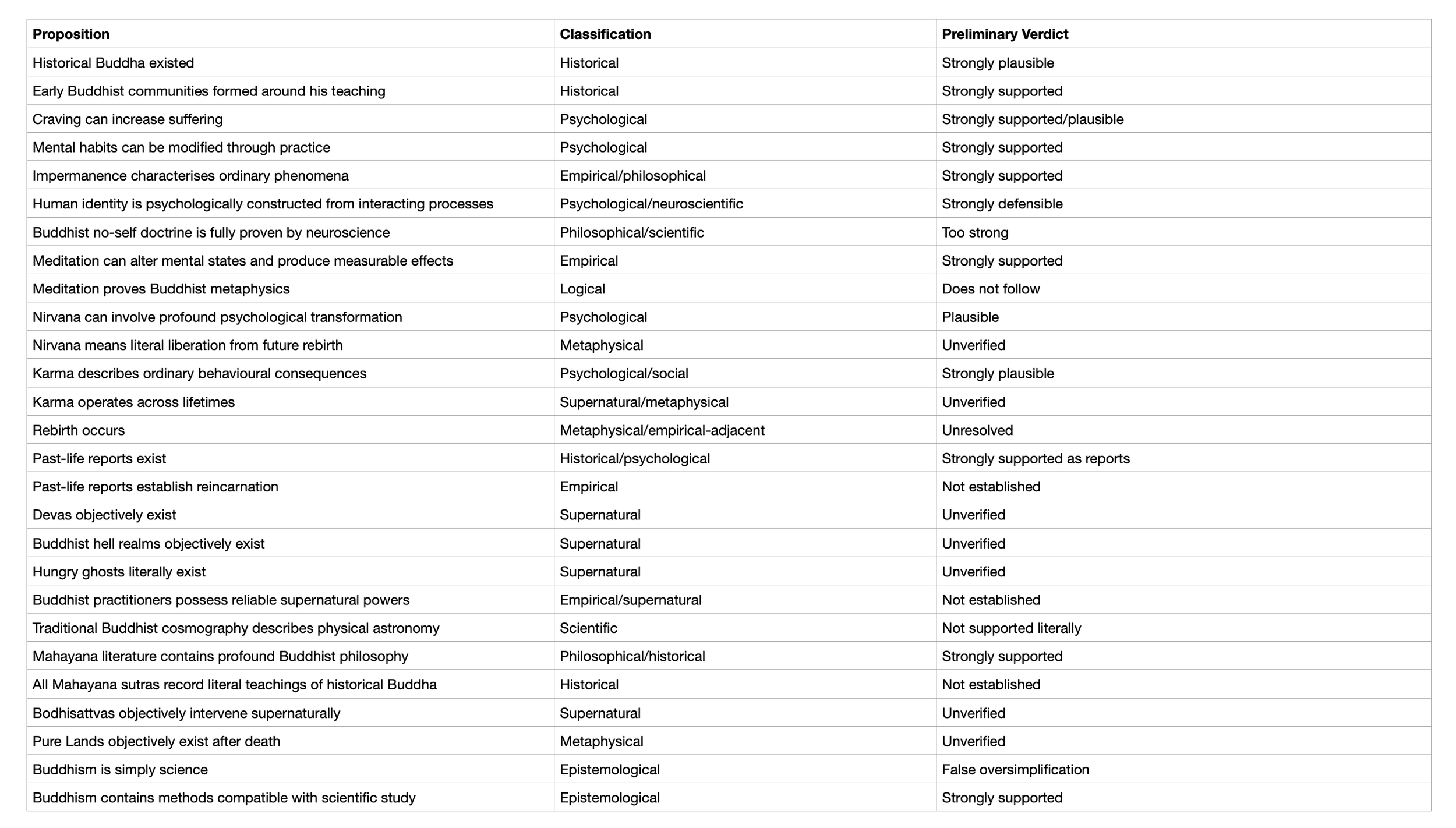
Every verdict remains provisional.
What Buddhism Must Surrender
For Buddhism to retain its reputation for intellectual openness, it should surrender:
the claim that meditation validates every Buddhist doctrine,
the portrayal of Buddhism as simply ancient neuroscience,
the assumption that rebirth is scientific fact,
the hiding of supernatural cosmology when marketing Buddhism as secular,
uncritical reverence toward monks or teachers,
the romanticisation of Buddhist institutions as automatically peaceful,
and
the use of “direct experience” as immunity from critical interpretation.
None of these are necessary for Buddhist practice to remain valuable.
What Buddhism Should Preserve
Preserve:
the disciplined study of attention.
the analysis of craving.
the investigation of suffering.
the emphasis on impermanence.
the ethics of compassion.
the challenge to rigid identity.
the contemplative technologies.
the philosophical sophistication.
the traditions of debate.
the suspicion of attachment to doctrine itself.
And especially preserve the possibility that a human being can observe their own mind and discover that many apparently permanent features of experience are actually processes.
That remains a profound insight.
Mahakali Judgment
Buddhism performs unusually well under an epistemic audit when it stays close to:
psychological observation,
contemplative practice,
ethical reasoning,
and philosophical investigation.
It performs considerably worse when traditional cosmology and supernatural claims are advertised as established science.
The strongest intellectually mature Buddhism can say:
“Meditation works in certain ways, and we should test exactly which ones.”
“The Buddha may have understood important features of the human mind without possessing modern neuroscience.”
“Rebirth is a traditional doctrine, not an established scientific conclusion.”
“A mystical experience is real as an experience; its interpretation remains open.”
“Ancient Buddhist cosmology can be culturally meaningful without being modern astronomy.”
“Monks can be wrong.”
“Scriptures can contain historical layers.”
“If evidence contradicts a traditional claim, we should investigate the evidence.”
This does not destroy Buddhism.
In many ways, it pushes Buddhism closer to one of its own deepest impulses:
Examine experience carefully.
Do not confuse attachment with truth.
Do not mistake certainty for insight.
And do not cling even to doctrine merely because it is ancient.
Mahakali Tribunal
Religious Epistemology Audit 04 — Buddhism
Useful is not the same as true. Ancient is not the same as infallible. Experience is not the same as interpretation.
Nothing Is Above Inquiry.