Islam Under the Epistemic Microscope - Qur’an, Hadith, Sira, Muhammad, Revelation, Jinn, Miracles, Law and the Question of What Is Actually True
Islam presents one of the clearest examples of why religious criticism must distinguish between scripture, history, theology, jurisprudence and later tradition.
“Islam says…” is usually too vague.
Does the claim come from:
the Qur’an?
a hadith?
a biographical tradition?
a legal school?
a medieval commentator?
a modern preacher?
a mystical tradition?
a political movement?
or a popular cultural belief?
These are not interchangeable.
A serious audit must separate them.
I. The Qur’an Is Not the Whole of Islam
The Qur’an is Islam’s central scripture.
But Islamic civilisation developed through much more than the Qur’an alone.
Major bodies of later tradition include:
Hadith
reports attributed to Muhammad and his companions.
Sira
biographical traditions concerning Muhammad’s life.
Tafsir
Qur’anic commentary.
Fiqh
jurisprudence.
Kalam
systematic theology.
Tasawwuf
mystical and Sufi traditions.
Legal schools
which developed differing methods and rulings.
Therefore an intellectual audit must begin with a basic rule:
Never attribute to the Qur’an what actually comes from later Islamic tradition.
This is essential for both critics and defenders.
II. Historical Muhammad
The historical existence of Muhammad is substantially more defensible than many supernatural claims associated with him.
The basic historical proposition that Muhammad was a seventh-century Arabian religious and political leader is widely accepted.
But again, several claims must be separated:
Did Muhammad exist?
Did he preach monotheism?
Did a community form around him?
Did he lead political and military activity?
Did he receive messages he sincerely believed were revelation?
Did Gabriel objectively transmit divine revelation?
Was Muhammad the final prophet of God?
These are different propositions.
Historical evidence can address some.
Theology addresses others.
The existence of a historical Muhammad does not independently establish prophethood.
III. Revelation
The central Islamic claim is extraordinary:
Muhammad received revelation from God.
Tradition identifies the angel Gabriel as the intermediary.
The historical question is:
Did Muhammad report revelatory experiences?
That is plausible.
The metaphysical question is:
Were those experiences actually communications from God?
That is much harder to establish.
Possible explanatory categories include:
genuine revelation,
mystical experience,
altered states of consciousness,
psychological phenomena,
cultural interpretation,
memory formation,
or other causes.
Historical sincerity and supernatural truth are different.
A person can sincerely believe they received revelation and still be mistaken about the source.
IV. The Qur’an as a Historical Text
The Qur’an deserves serious historical study as an early Islamic text.
Questions include:
When were individual passages first recited?
How were they transmitted?
When were they compiled?
How stable was the text?
What manuscript evidence exists?
What role did early political authority play in standardisation?
Were variant readings preserved?
What changed, if anything, during transmission?
These are not anti-Islamic questions.
They are standard historical questions.
No scripture should be exempt from textual criticism.
V. Preservation
Muslim apologetics often emphasise the preservation of the Qur’an.
Textual preservation is historically important.
But two separate propositions must not be confused:
The text was preserved with high fidelity.
and:
The text is therefore divinely authored.
Even perfect preservation would establish preservation.
It would not establish supernatural origin.
A false statement can be transmitted perfectly.
A true statement can be transmitted imperfectly.
Preservation and truth are distinct variables.
VI. The Qur’an’s Literary Power
The Qur’an has enormous literary, devotional and civilisational importance.
Its Arabic form shaped:
language,
law,
poetry,
politics,
ritual,
ethics,
architecture,
education,
and collective identity.
For believers, recitation itself carries sacred power.
None of this should be mocked.
But aesthetic force does not prove supernatural authorship.
A text can be magnificent and human.
A text can be ordinary and true.
Beauty and truth must remain separate categories.
VII. “No Human Could Have Written This”
One apologetic argument holds that the Qur’an’s literary quality proves divine origin.
This is difficult to turn into an objective test.
Literary excellence is partly aesthetic.
Even if a text is exceptionally powerful, the inference:
therefore God wrote it
does not automatically follow.
Human civilisation has produced extraordinary:
poetry,
music,
mathematics,
architecture,
philosophy,
and literature.
The existence of genius does not itself prove supernatural authorship.
A stronger argument would require independently demonstrating that human authorship is genuinely impossible.
That is a very high burden.
VIII. Qur’anic Cosmology and Natural Claims
The Qur’an contains statements about:
creation,
the heavens,
the earth,
human development,
rain,
celestial bodies,
natural processes,
and the structure of the cosmos.
Interpretation matters enormously.
Some passages are poetic.
Some are theological.
Some may reflect ordinary premodern cosmological language.
The key methodological question is:
Were these passages intended as precise scientific propositions?
If not, modern believers should be cautious about turning them into modern science.
If yes, then they are open to scientific scrutiny.
IX. “Scientific Miracles in the Qur’an”
This is one of the most important modern claims to audit.
Popular apologetics sometimes argues that the Qur’an predicted:
embryology,
the Big Bang,
expansion of the universe,
mountain geology,
oceanography,
atmospheric science,
or other modern discoveries.
The methodological test must be severe.
Did the passage clearly state the scientific idea before the modern discovery?
Was the interpretation common before the discovery?
Is the wording specific?
Could a scientist have derived the modern theory from the verse alone?
Does the interpretation require modern concepts to be projected backward?
If the scientific discovery came first and the “prediction” appeared later, that is usually retrospective pattern matching.
Islam does not need fake scientific miracles to preserve its religious or literary significance.
X. Embryology Claims
One popular argument concerns Qur’anic descriptions of embryonic development.
The important questions are:
How precise is the language?
How did people in Late Antiquity already understand reproduction?
How much similarity exists with earlier medical traditions?
Do the descriptions correspond exactly with modern embryology?
Or are modern interpretations more precise than the original wording?
Ancient observations about pregnancy can be historically interesting.
They become miraculous only if they contain genuinely inaccessible, accurate and specific knowledge.
That must be demonstrated, not assumed.
XI. Creation of Humanity
Islamic tradition includes Adam as a primordial human figure.
The epistemic issue resembles the Christian case.
A literal model of special creation of the first human being must be considered alongside evolutionary biology and population genetics.
Many Muslims interpret Adam in different ways.
Some accept evolution partially.
Others reject common ancestry.
The scientific evidence for evolution does not depend upon theological preference.
Where a literal interpretation directly conflicts with strong biological evidence, the interpretation—not biology—should carry the burden of adjustment.
XII. Noah and the Flood
Islam also incorporates Noahic flood traditions.
Again, the scope matters.
A regional flood is historically plausible.
A global flood covering the entire planet creates severe geological and ecological problems.
The Qur’an need not necessarily be read in the most maximalist global-flood interpretation.
Where literal interpretations exceed available evidence, confidence should fall.
XIII. Moses, Jesus and Earlier Prophets
The Qur’an incorporates earlier prophetic figures, including:
Adam,
Noah,
Abraham,
Moses,
and Jesus.
This creates historical overlap with Jewish and Christian traditions.
But the Qur’an sometimes presents these figures differently from earlier sources.
That raises important questions.
Did the Qur’an preserve independent historical information?
Did it reinterpret earlier traditions?
Did oral religious traditions influence its narratives?
Which version is historically strongest where accounts conflict?
Religious authority cannot settle a historical dispute by itself.
Competing sacred traditions require external methods.
XIV. Jesus in Islam
Islam accepts Jesus as a major prophet and Messiah but rejects central Christian claims about his divinity.
Traditional Islamic interpretations also reject or radically reinterpret the crucifixion narrative.
This creates direct conflict with mainstream historical scholarship, which generally regards Jesus’ crucifixion as historically very strong.
If one text written centuries later contradicts earlier historical sources, the later text does not automatically win merely because it claims revelation.
The evidentiary burden rises.
This is an example of why revelation cannot exempt itself from chronology and source criticism.
XV. Miracles
Islamic tradition includes miracle claims associated with prophets.
These may include:
extraordinary signs,
supernatural interventions,
visions,
and events outside ordinary physical expectation.
The same rule applies as elsewhere:
Extraordinary claims require extraordinary evidence.
A miracle tradition may preserve sincere testimony.
It may also reflect:
legend formation,
symbolism,
devotional expansion,
memory distortion,
or theological storytelling.
Each case must be examined separately.
XVI. The Splitting of the Moon
One famous miracle tradition claims that the Moon was split.
If interpreted as a large-scale physical astronomical event, the claim would be extraordinary.
It would invite questions such as:
Would other civilisations have observed it?
Would astronomical or geological evidence exist?
Are there independent contemporary records?
If evidence outside the religious tradition is absent, the evidentiary burden remains unmet.
A theological miracle claim is one thing.
A global astronomical claim is another.
XVII. Isra and Mi’raj
The Night Journey and Ascension occupy an important place in Islamic tradition.
Different interpretations exist.
Literal supernatural journey?
Visionary experience?
Mystical revelation?
Symbolic narrative?
These possibilities create different epistemic burdens.
A private visionary experience is historically plausible as experience.
A literal physical journey involving supernatural realms requires stronger evidence.
Again:
experience and interpretation must remain separate.
XVIII. Jinn
Jinn are among Islam’s most distinctive supernatural claims.
Traditional descriptions assign them agency and intelligence.
Belief in jinn can function culturally, theologically and psychologically.
But if jinn objectively interact with the physical world, they become empirically relevant.
Claims of:
possession,
physical interference,
communication,
or measurable effects
should be investigated under controlled conditions.
At present, jinn are not established entities in mainstream science.
Therefore:
Jinn as theological beings: central to tradition.
Jinn as scientifically established organisms or agents: unverified.
XIX. Jinn, Possession and Mental Health
This is where epistemology becomes ethically serious.
Behaviour attributed to jinn may overlap with:
psychosis,
dissociation,
epilepsy,
trauma,
sleep disorders,
neurological illness,
cultural expectation,
or other conditions.
Religious interpretations must never prevent medical evaluation.
A spiritual explanation may coexist with personal belief.
It should not replace evidence-based healthcare where illness is possible.
Religious certainty becomes harmful when it delays treatment.
XX. Hadith: A Different Epistemic Problem
Hadith literature requires separate treatment from the Qur’an.
Hadith collections contain reports attributed to Muhammad and early Muslims.
Scholars developed sophisticated systems to assess transmitters and chains of transmission.
That scholarly achievement deserves respect.
But the existence of an authentication system does not automatically make every authenticated report equivalent to modern historical certainty.
Questions remain:
How long after the alleged event was the report recorded?
How reliable were transmitters?
Could political or sectarian interests shape transmission?
Could oral reports evolve?
How independent were different chains?
Could isnads themselves be constructed retrospectively?
These are normal historical questions.
XXI. “Sahih” Does Not Mean “Scientifically Proven”
Within hadith sciences, a report can be classified according to established methodological criteria.
But a theological-historical category such as sahih should not be confused with:
laboratory verification,
direct recording,
or modern forensic certainty.
It means the report passed a traditional authentication methodology.
That methodology itself can be studied and criticised.
Respecting Islamic scholarship does not require treating it as epistemically infallible.
XXII. Hadith Contradictions and Tensions
Large hadith corpora inevitably generate:
tensions,
different versions,
context disputes,
apparent contradictions,
and differing legal interpretations.
Scholars developed methods to reconcile or prioritise reports.
This demonstrates intellectual sophistication.
It also demonstrates something more basic:
The corpus is historically complex.
When a modern believer treats every reported statement as though it were an audio recording from the seventh century, nuance disappears.
A serious audit must distinguish degrees of historical confidence.
XXIII. Sira: Biography or Sacred History?
Biographical traditions about Muhammad contain enormous religious importance.
But many surviving narratives were written after the events they describe.
This does not make them worthless.
Ancient history often depends on later sources.
But historical distance increases the need for critical analysis.
Questions include:
What earlier materials did biographers use?
Which stories have independent corroboration?
Which accounts appear apologetic?
Which appear polemical?
Which may have served later legal or political needs?
Biography is evidence.
It is not automatic certainty.
XXIV. Prophecy
Islamic tradition includes prophetic claims and predictions.
These should be tested using the same standards established in Audit 00.
A strong prophecy should be:
specific,
clearly documented before fulfilment,
not vague,
not self-fulfilling,
and unlikely to occur by ordinary expectation.
If a prophecy can be endlessly reinterpreted after events happen, its evidentiary value drops.
Apocalyptic language is especially vulnerable to retrofitting.
XXV. The Final Prophet Claim
Islam holds Muhammad to be the final prophet.
This is an important theological claim.
But what evidence could independently establish that no future genuine prophet could ever exist?
The proposition is difficult to test externally.
It depends heavily upon accepting Islamic revelation itself.
Therefore:
Finality of prophethood: central Islamic theology.
Independent empirical demonstration: unavailable.
XXVI. Angels
Angels are central to Islamic cosmology.
Gabriel in particular plays a foundational role.
But angels are not empirically established entities in modern science.
Reports of angelic encounters may involve:
religious experience,
visions,
dreams,
altered states,
or unknown phenomena.
The evidence supports the existence of reports.
It does not automatically establish the ontology of angels.
XXVII. Heaven and Hell
Islamic scripture and tradition contain vivid descriptions of:
paradise,
judgment,
reward,
punishment,
and hell.
These claims are morally and psychologically powerful.
But post-mortem realms remain metaphysical propositions.
No scientific consensus establishes:
Jannah,
Jahannam,
or divine judgment after death.
Believers may accept them as revelation.
They should not be presented as empirically demonstrated geography.
XXVIII. Eternal Punishment
Hell creates ethical questions similar to those in Christianity.
Can finite wrongdoing justify potentially eternal punishment?
What about sincere nonbelief?
What about people exposed only to distorted versions of Islam?
How does divine mercy relate to eternal punishment?
Different Islamic theologians have responded differently.
These are not merely emotional objections.
They are serious questions about proportionality, justice and moral coherence.
If God is perfectly just, the conception of punishment should itself survive ethical scrutiny.
XXIX. Sharia Is Not One Thing
“Sharia” is frequently discussed as though it were a single legal code.
Historically, Islamic law developed through:
Qur’anic material,
hadith,
analogy,
consensus,
jurisprudential reasoning,
custom,
and differing legal schools.
This distinction is critical.
Divine revelation and human jurisprudence are not identical.
A legal ruling developed by a medieval jurist remains a human interpretation even if motivated by scripture.
Treating all historical jurisprudence as eternally divine eliminates the possibility of moral development.
XXX. Apostasy and Blasphemy
Religious truth should not require criminal punishment for doubt.
If an idea is true, leaving it does not make it false.
If a prophet’s claims are historically strong, criticism cannot destroy them.
Laws punishing:
apostasy,
blasphemy,
heresy,
or peaceful theological dissent
create a serious epistemic problem.
Coercion corrupts the information environment.
If people are punished for expressing disbelief, apparent religious consensus becomes unreliable.
Fear cannot constitute evidence.
XXXI. Women and Religious Law
Some traditional Islamic legal interpretations contain rules that modern societies may regard as unequal concerning:
marriage,
divorce,
inheritance,
testimony,
dress,
sexual autonomy,
or public roles.
Defenders often argue context, complementarity or divine authority.
Critics argue inequality.
The key Mahakali principle is:
No moral command becomes immune from ethical examination because it is attributed to God.
If a rule is just, arguments should be capable of defending its justice.
“God commanded it” cannot be the end of moral reasoning unless divine authorship has already been independently established.
XXXII. Slavery
Islam emerged in a world where slavery was widespread.
Islamic sources contain both regulation of slavery and encouragement of manumission.
Historically, Muslim societies also participated in slave systems.
Modern Muslim thinkers generally reject slavery.
This produces an important civilisational lesson.
Traditions can morally evolve beyond historical institutions embedded in scripture or jurisprudence.
That evolution should be acknowledged rather than denied.
The ability to say:
“This historical norm should no longer govern human society”
is a sign of moral maturity.
XXXIII. Warfare
Islamic texts emerged in a context involving actual political conflict.
Verses concerning warfare therefore require historical context.
Problems arise when:
contextual wartime instructions are universalised,
later militants cherry-pick passages,
or critics quote verses without historical setting.
Both apologetic sanitisation and hostile decontextualisation distort the record.
A serious audit asks:
Who was addressed?
Under what circumstances?
Was the rule defensive, offensive, political or universal?
How was it interpreted historically?
How should it be evaluated ethically today?
XXXIV. Abrogation
Islamic jurisprudence developed theories concerning whether some revelations modify or supersede others.
This raises an obvious epistemic question:
Why would perfect revelation require chronological legal modification?
Believers may answer that revelation responded progressively to changing circumstances.
That is philosophically possible.
But it also demonstrates that context matters.
If context mattered during revelation, context should remain relevant when interpreting law today.
XXXV. Free Will and Predestination
Islamic theology contains long-standing debates concerning:
human freedom,
divine foreknowledge,
divine decree,
and moral responsibility.
If God knows and determines everything, in what sense are humans free?
If humans are genuinely free, what exactly does divine determination mean?
Muslim theologians have developed sophisticated answers.
But the tension remains philosophically significant.
This is not uniquely Islamic.
It appears in many monotheistic systems.
XXXVI. The Problem of Evil
If Allah is:
all-powerful,
all-knowing,
and perfectly merciful,
why does apparently unnecessary suffering exist?
Natural disasters.
Childhood disease.
Extreme cruelty.
Predation.
Genetic illness.
Religious traditions offer responses:
free will,
soul-making,
divine wisdom,
afterlife compensation,
human epistemic limitation,
and testing.
These arguments deserve philosophical examination.
But none automatically solves every version of the problem.
The existence of suffering remains one of classical theism’s hardest questions.
XXXVII. Prayer
Islamic prayer has clear social and psychological dimensions.
It can provide:
structure,
discipline,
community,
attention,
identity,
meditative rhythm,
and meaning.
These can be studied empirically.
A separate claim is:
Allah intervenes physically in response to particular prayers.
That requires different evidence.
Religious practice can be useful without every causal explanation being proven.
XXXVIII. Fasting
Ramadan fasting also demonstrates why religious analysis should not become simplistic.
Fasting can have:
social,
psychological,
ritual,
metabolic,
and health consequences.
Some may be beneficial.
Some individuals may face medical risks.
Whether a practice is religiously commanded does not settle medical questions.
Health claims should be tested with health evidence.
XXXIX. Sufism and Mystical Experience
Sufism contains some of Islam’s richest traditions concerning:
love,
ego dissolution,
divine unity,
remembrance,
music,
poetry,
and mystical experience.
Reports of mystical union deserve the same treatment as other religious experiences.
The experience can be authentic as phenomenology.
The theological interpretation remains a separate question.
A Sufi may experience overwhelming unity with God.
A Hindu mystic may interpret a similar state as Brahman.
A Buddhist may interpret it through emptiness or non-self.
This cross-cultural variation should create epistemic humility.
XL. Islam’s Greatest Epistemic Strength
Islam contains strong traditions of:
scholarship,
textual preservation,
law,
logic,
philosophy,
theology,
medicine,
astronomy,
linguistics,
and intellectual debate.
Classical Islamic civilisation produced major achievements partly because knowledge was taken seriously.
Islamic theology also contains a powerful emphasis on:
intention,
justice,
charity,
discipline,
and the limits of human arrogance.
These resources can support epistemic humility.
XLI. Islam’s Greatest Epistemic Weakness
The greatest weakness appears when one proposition dominates everything:
The Qur’an cannot possibly contain error, therefore every conflict must be resolved in its favour.
Once this premise becomes non-negotiable:
historical criticism becomes threatening,
science must be reinterpreted,
moral objections become rebellion,
and contradictory evidence becomes suspect.
This is the same structural problem encountered in other forms of scriptural inerrancy.
The issue is not uniquely Islamic.
It is a general problem of infallibility.
XLII. Islam and the Problem of Interpretive Flexibility
Islamic apologetics sometimes alternates between literalism and metaphor depending upon evidentiary pressure.
A passage is literal when it appears compatible with modern knowledge.
It becomes metaphorical when literalism creates difficulty.
This is not automatically dishonest.
All ancient texts require interpretation.
The problem begins when the rules change opportunistically.
A credible interpretive method should be established before the evidence is known.
Otherwise theology becomes infinitely elastic.
The Preliminary Mahakali Ledger
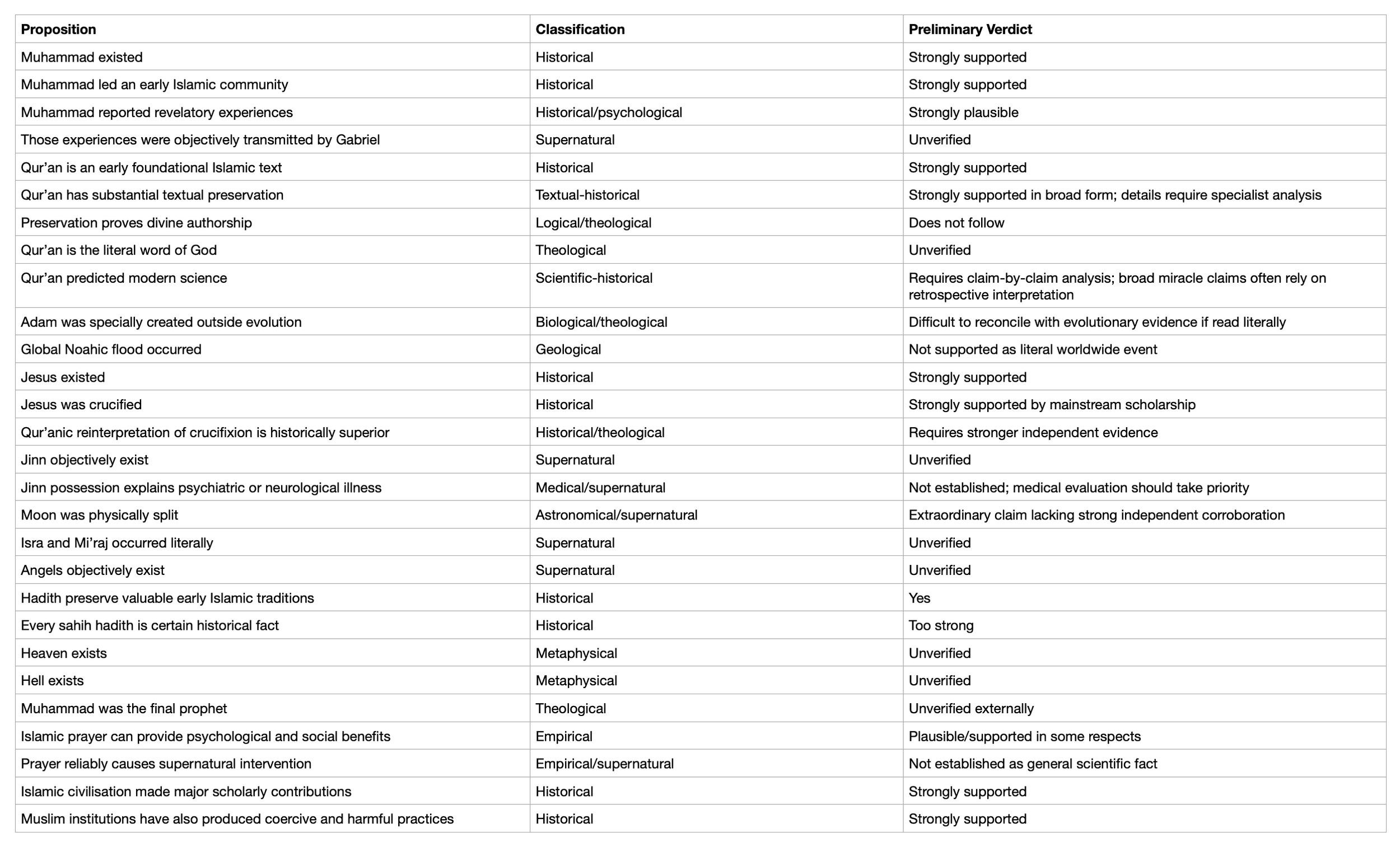
Every verdict remains revisable.
What Islam Must Surrender
For Islam to coexist confidently with modern epistemology, Muslim intellectual culture should be willing to surrender:
scientific-miracle arguments based on retrospective reinterpretation,
the assumption that traditional authentication equals modern historical certainty,
the use of supernatural explanations as substitutes for medical care,
punishment for peaceful doubt,
the idea that criticism of scripture is inherently immoral,
the automatic equation of medieval jurisprudence with timeless divine law,
and
the belief that revelation exempts historical claims from historical scrutiny.
None of these are necessary for Muslim identity to survive.
What Islam Should Preserve
Preserve:
the discipline.
the architecture.
the poetry.
the calligraphy.
the charitable traditions.
the emphasis on intention.
the insistence that wealth creates obligations.
the intellectual heritage.
the mathematical and scientific history.
the philosophical tradition.
the mystical literature.
the sense of moral accountability.
the global civilisational memory.
And preserve one especially valuable idea:
Human beings are not ultimate.
That insight can produce humility rather than authoritarianism if interpreted wisely.
Mahakali Judgment
Islam is not one proposition capable of being marked simply:
TRUE
or
FALSE.
It contains:
historically strong propositions,
historically uncertain traditions,
powerful ethical frameworks,
complex legal developments,
unverified supernatural claims,
metaphysical doctrines,
literary achievement,
mysticism,
and centuries of human interpretation.
The strongest intellectually mature form of Islam would be capable of saying:
“The Qur’an is sacred to me, but my interpretation can be wrong.”
“Hadith scholarship is sophisticated, but historical certainty varies.”
“My mystical experience is meaningful, but it does not compel everyone else to accept my interpretation.”
“Science does not need to be hidden inside scripture for scripture to matter.”
“A medieval jurist was a human being.”
“Religious coercion proves nothing.”
“Mental illness should receive medical treatment even when spiritual beliefs remain important.”
“If historical evidence creates difficulty for my interpretation, I will examine the evidence rather than suppress it.”
Such an Islam would not be weakened by inquiry.
It would become more intellectually defensible.
Because the central conflict facing Islam is not:
Islam versus the West.
Nor:
Islam versus atheism.
It is the same conflict facing every civilisation:
Infallibility versus correction.
A religion confident in truth should not fear criticism.
A scripture confident in meaning should not require censorship.
A God worthy of worship should not need fragile human institutions to protect Him from questions.
Mahakali Tribunal
Religious Epistemology Audit 03 — Islam
Sacredness does not cancel the burden of proof.
Nothing Is Above Inquiry.