Christianity Under the Epistemic Microscope - Hebrew Bible, Historical Jesus, Gospels, Resurrection, Paul, Trinity, Heaven, Hell and the Question of What Is Actually True
Christianity is often discussed as though it were one claim.
It is not.
It is a civilisation-sized stack of claims layered over centuries:
Jewish scripture.
Second Temple Judaism.
The historical Jesus.
Early Christian communities.
Pauline theology.
Gospel traditions.
Church councils.
Creeds.
Mysticism.
Institutional Christianity.
Catholicism.
Orthodoxy.
Protestantism.
Evangelicalism.
Modern fundamentalism.
And enormous bodies of later commentary.
A ruthless audit must therefore begin by rejecting the sentence:
“The Bible says…”
Which Bible?
Which book?
Which author?
Which manuscript tradition?
Which historical period?
Which interpretation?
Which denomination?
Which theological framework?
Christianity cannot be audited honestly until its layers are separated.
I. The Bible Is a Library
The Bible is not one book written by one person at one moment.
It is a collection.
The Hebrew Bible contains law, poetry, genealogy, prophecy, wisdom literature, theological narrative and historical memory.
The New Testament contains Gospels, letters, theological writings and apocalyptic literature.
Different authors wrote for different communities under different circumstances.
That matters enormously.
A library should not be treated like a single eyewitness statement.
Internal differences are therefore expected.
But when believers claim perfect factual consistency across the entire collection, those differences become epistemically relevant.
II. Genesis: Theology or Natural Science?
Genesis contains some of the most influential creation narratives in human history.
Its cultural significance is enormous.
Its literal scientific usefulness is another matter.
A strict literal reading can involve:
a recent creation,
special creation of humans,
an original couple from whom all humanity descends,
extraordinary early lifespans,
and a global flood.
Modern geology, genetics, evolutionary biology, astronomy and palaeontology create major problems for such readings.
This does not prove Christianity false.
It does show that:
Genesis is not a reliable replacement for modern cosmology, geology or evolutionary biology.
A symbolic or theological reading avoids many of these conflicts.
That tells us something important:
Christianity becomes more epistemically resilient as it becomes less scientifically literal.
III. Adam and Eve
Did two historical individuals constitute the sole biological origin of the human species in the recent past?
Modern population genetics strongly complicates such a model.
Human ancestry is population-based.
Evolutionary history does not point toward a simple recent bottleneck of exactly two individuals corresponding to a literal reading.
Theologically, Adam and Eve can still function as symbols of:
moral awakening,
human alienation,
disobedience,
freedom,
mortality,
or the human condition.
But symbolism and population genetics are different categories.
Literal recent universal ancestry from one pair: scientifically difficult to defend.
Theological symbolism: philosophically available.
IV. Noah and the Flood
A worldwide flood covering all land and preserving terrestrial animal life through one vessel creates enormous geological, ecological and logistical problems.
Flood traditions exist across many cultures.
Regional catastrophic floods are historically plausible.
A universal flood affecting the entire planet in the straightforward literal sense is not supported by mainstream geology.
Therefore:
Regional flood memories influencing religious traditions: plausible.
Global flood as literal geological history: not supported.
Again, the story may possess profound theological meaning without functioning as modern earth science.
V. Exodus
The Exodus narrative sits near the centre of Jewish and Christian sacred history.
But historical investigation must separate:
the theological importance of Exodus,
possible memories of migrations or smaller historical events,
and the literal historicity of the entire narrative at the scale traditionally imagined.
Archaeology has not produced straightforward confirmation for every major element of the traditional account.
That does not mean every historical core is impossible.
It means confidence should remain proportional to evidence.
Sacred importance does not automatically create archaeological confirmation.
VI. Biblical Archaeology: What It Can and Cannot Prove
Archaeology can establish:
cities,
settlements,
rulers,
inscriptions,
trade,
wars,
destruction layers,
material cultures,
and political contexts.
But archaeology has limits.
Suppose archaeology confirms that a city mentioned in scripture existed.
That proves the city existed.
It does not prove:
angels appeared there,
God issued commands there,
miracles occurred there,
or every event associated with that city happened exactly as narrated.
Historical corroboration should never be used to smuggle supernatural conclusions into the evidence.
VII. The Historical Jesus
The historical existence of Jesus is substantially more defensible than many supernatural claims made about him.
The important distinction is:
Did Jesus exist?
versus
Was Jesus God incarnate?
These are not the same question.
A historical preacher named Jesus operating in first-century Roman Judea is historically plausible and widely accepted by scholars.
But establishing the existence of a historical person does not establish:
virgin birth,
miracles,
divine nature,
resurrection,
or cosmic salvation.
Historical existence creates a foundation.
It does not authenticate every theological claim built upon it.
VIII. Jesus the Teacher
Many teachings attributed to Jesus have extraordinary ethical power.
Love of neighbour.
Concern for the poor.
Forgiveness.
Humility.
Criticism of hypocrisy.
Attention to inner motive.
Compassion toward social outsiders.
But ethical brilliance does not prove divinity.
Socrates can be philosophically profound without being a god.
The Buddha can offer extraordinary insight without supernatural authentication.
Likewise Jesus can be one of history’s most important moral teachers even before deciding any metaphysical question about him.
Separating ethics from divinity strengthens analysis.
IX. The Gospels
The Gospels are among the most important documents in Western civilisation.
But they are theological narratives as well as historical sources.
The critical questions include:
Who wrote them?
When?
What sources did they use?
How much oral transmission occurred?
How much theological development took place?
Where do accounts differ?
Which details reflect historical memory and which reflect later interpretation?
The Gospels are valuable historical evidence.
They are not neutral transcripts.
Recognising that does not destroy Christianity.
It simply places the texts within the same historical methods applied to other ancient documents.
X. Gospel Differences
Differences across Gospel accounts matter because they reveal multiple traditions and theological emphases.
Events can be arranged differently.
Genealogies differ.
Narrative details differ.
Resurrection accounts differ in important particulars.
Theological presentation evolves.
Fundamentalist systems often attempt elaborate harmonisation.
Sometimes reconciliation is plausible.
Sometimes it is strained.
The key principle should be:
Apparent tension should be investigated, not automatically erased.
If a text is claimed to be perfectly consistent, internal differences become relevant evidence.
XI. Virgin Birth
The virgin birth is a supernatural biological claim.
Historical testimony can support belief.
But biology gives us strong expectations about ordinary human reproduction.
A virgin conception would therefore require extraordinary evidence.
The claim cannot be validated merely because a sacred text reports it.
Possible interpretations include:
literal miracle,
theological symbolism,
legend formation,
or later narrative development.
Without independent verification, the claim remains theological rather than scientifically established.
XII. Miracles of Jesus
Healing.
Walking on water.
Multiplying food.
Exorcisms.
Controlling weather.
Raising the dead.
These are extraordinary claims.
Some healing stories could potentially involve:
misdiagnosis,
spontaneous remission,
psychosomatic mechanisms,
story development,
symbolic narration,
or extraordinary events not presently explained.
But no miracle should receive automatic exemption from alternative explanations.
The correct epistemic question is:
What evidence distinguishes supernatural intervention from natural explanation, error or legend?
The more extraordinary the miracle, the stronger that burden becomes.
XIII. Resurrection: Christianity’s Central Claim
Christianity stands or falls more dramatically on resurrection than on almost any other proposition.
This deserves serious treatment.
Several questions must be separated:
Was Jesus crucified?
Did followers later sincerely believe he was alive?
Were there visionary experiences?
Was the tomb empty?
Did a biological resurrection occur?
These are different propositions.
The crucifixion itself is historically much easier to defend than bodily resurrection.
Sincere post-death experiences by followers are also psychologically plausible.
But a dead human returning bodily to life is an extraordinary biological event.
Testimony may justify faith.
Whether it establishes the event beyond reasonable historical doubt is a much more demanding question.
XIV. “People Would Not Die for a Lie”
A common apologetic argument says early Christians suffered or died for their beliefs, therefore those beliefs must have been true.
This reasoning fails.
People can sincerely die for false beliefs.
History provides countless examples.
Martyrdom demonstrates conviction.
It does not demonstrate factual accuracy.
A disciple being willing to suffer may increase confidence that the disciple sincerely believed something.
It cannot by itself establish that the underlying supernatural interpretation was correct.
Sincerity is not verification.
XV. Paul
Paul is one of the most consequential figures in Christian history.
His writings deeply shaped Christian theology.
Questions include:
How closely did Paul’s theology match the historical Jesus?
How much did Christianity change as it expanded into the Greco-Roman world?
Which doctrines were emphasised differently in Pauline communities?
Was later Christianity primarily the religion of Jesus or increasingly a religion about Jesus?
These are historical and theological questions, not insults.
The development of Christianity matters because religious systems frequently present later doctrine as though it existed fully formed from the beginning.
History is usually more complicated.
XVI. Did Jesus Claim to Be God?
This is more complex than popular Christian discourse often suggests.
Different New Testament writings present Jesus in different theological registers.
Some statements strongly support exalted or divine interpretations.
Others fit more comfortably within prophetic, messianic or Jewish religious categories.
The development of Christology became one of early Christianity’s central debates.
Therefore the simplistic formulation:
“Jesus clearly taught the later Nicene doctrine in exactly its final form”
requires much more argument than many believers assume.
XVII. The Trinity
The Trinity is one of Christianity’s most sophisticated theological constructions.
Father.
Son.
Holy Spirit.
One God.
Three persons.
The doctrine attempts to reconcile:
monotheism,
the divinity of Christ,
and the experienced reality of the Spirit.
But the fully developed doctrine emerged through theological controversy and ecclesiastical formulation.
From an epistemological standpoint:
The Trinity is a theological model.
It is not an empirical discovery.
Its coherence can be philosophically debated.
Its supernatural truth cannot be experimentally demonstrated.
A doctrine becoming orthodox through councils demonstrates institutional theological settlement.
It does not transform metaphysics into science.
XVIII. Church Councils and the Formation of Orthodoxy
Christian orthodoxy developed historically.
Councils debated:
Christology,
divinity,
humanity,
heresy,
creeds,
canonical boundaries,
and institutional doctrine.
Winners became orthodox.
Losers became heretical.
That does not automatically mean orthodoxy was false.
Nor does it mean political power alone created doctrine.
But it destroys the illusion that Christianity descended from heaven as one perfectly settled theological package.
It developed through human argument.
That historical reality should be acknowledged openly.
XIX. Canon Formation
Why are some books in the New Testament and others outside it?
The answer involves:
usage,
apostolic association,
theological compatibility,
church tradition,
regional acceptance,
and historical processes.
This raises an important epistemic question.
If the canon is divinely guaranteed, what independently demonstrates that divine guarantee?
A church authenticating the scripture and scripture authenticating the church can become circular.
Historical canon formation is demonstrable.
Supernatural canon guarantee remains theological.
XX. Heaven
What exactly is heaven?
A physical place?
A transformed state?
Union with God?
A post-mortem dimension?
Resurrection into a renewed creation?
Different Christian traditions answer differently.
The more physically specific the claim becomes, the more it approaches potential empirical investigation.
But ordinary science has not established heaven as an observed post-mortem realm.
Therefore:
Heaven as theological hope: legitimate belief category.
Heaven as scientifically demonstrated geography: unsupported.
XXI. Hell
Hell may be one of Christianity’s most morally difficult doctrines.
Questions include:
Is punishment eternal?
Is hell literal fire?
Is it separation from God?
Is punishment temporary?
Does annihilation occur?
Can finite wrongdoing justify infinite punishment?
Do people deserve eternal torment for incorrect belief?
Christian traditions disagree.
Theologically, hell can be interpreted in multiple ways.
Ethically, eternal conscious torment creates serious proportionality problems.
A doctrine being ancient does not exempt it from moral criticism.
XXII. Satan and Demons
Christian traditions attribute varying degrees of reality and agency to Satan and demonic beings.
These claims interact dangerously with psychology and medicine when literal supernatural explanations replace evidence-based diagnosis.
Experiences once attributed to demonic possession may overlap with:
epilepsy,
psychosis,
dissociation,
sleep phenomena,
neurological disorders,
trauma,
cultural expectation,
or other medical conditions.
This does not logically prove that demons cannot exist.
It does mean supernatural diagnosis should never be privileged over evidence-based medical investigation.
When religion interferes with healthcare, epistemic error can become physical harm.
XXIII. Exorcism
Exorcism presents a perfect case for controlled investigation.
If an allegedly supernatural entity produces observable effects beyond ordinary human ability, those effects should be measurable.
If symptoms can be explained through psychology, neurology or social mechanisms, those explanations deserve priority.
Exorcism practices become especially dangerous when they involve:
violence,
restraint,
deprivation,
medical neglect,
or coercion.
Religious freedom does not justify harming vulnerable people.
XXIV. Biblical Prophecy
Prophecy must be tested carefully.
Strong prophecy should ideally be:
specific,
documented before the event,
unlikely to occur by chance,
not dependent upon vague interpretation,
and not fulfilled through deliberate human action designed to match the prophecy.
Retrospective interpretation dramatically weakens evidentiary value.
A prophecy that can fit numerous outcomes predicts very little.
The correct audit therefore asks:
What exactly was predicted, when was it documented, and how improbable was the fulfilment?
XXV. Revelation
Christianity ultimately depends upon revelation.
God reveals truth through:
scripture,
prophets,
Jesus,
the Spirit,
or religious experience.
The epistemic difficulty is that other religions make analogous claims.
Muslims claim revelation.
Hindus claim revelation.
Mormons claim revelation.
Mystics across traditions report divine contact.
These revelations frequently contradict one another.
Therefore:
Revelation cannot authenticate itself merely through subjective certainty.
Either some revelations are mistaken, or their interpretations are.
Once that is admitted, external standards become necessary.
XXVI. Prayer
Prayer can serve multiple functions:
reflection,
emotional regulation,
ritual,
community,
hope,
attention,
gratitude,
and perceived relationship with God.
Those psychological and social functions can be studied.
A separate claim is:
intercessory prayer reliably produces supernatural physical outcomes.
That is empirically testable in principle.
Religious practice may be meaningful even if supernatural causality is not demonstrated.
Again, usefulness and truth must remain separate.
XXVII. Creationism and Intelligent Design
Modern young-earth creationism represents one of the clearest conflicts between Christian literalism and modern science.
Evolutionary biology is supported by converging evidence from:
genetics,
fossils,
comparative anatomy,
biogeography,
molecular biology,
and observed evolutionary processes.
Rejecting this enormous body of evidence because of a particular interpretation of Genesis reverses the scientific method.
Doctrine becomes fixed.
Evidence becomes negotiable.
That is epistemically backwards.
A Christian can accept evolution.
Millions do.
The conflict is therefore not fundamentally:
Christianity versus evolution.
It is:
biblical literalism versus evidence.
XXVIII. “Fine-Tuning Proves God”
Modern Christian apologetics often invokes fine-tuning.
The apparent suitability of physical constants for complex structures raises legitimate philosophical questions.
Possible explanations include:
design,
selection effects,
multiverse models,
deeper physical necessity,
unknown cosmology,
or other possibilities.
Fine-tuning arguments can be philosophically serious.
But:
interesting philosophical argument
is not equivalent to
empirical proof of the Christian God.
Even if design were established, an enormous additional argument would be required to identify the designer specifically with Christian theology.
XXIX. Morality and Christianity
Christianity has inspired:
charity,
hospitals,
education,
abolitionist movements,
human-rights activism,
art,
music,
community,
and extraordinary personal sacrifice.
Christian institutions have also participated in:
persecution,
forced conversion,
colonialism,
sectarian violence,
antisemitism,
sexual repression,
institutional abuse,
and censorship.
Neither side proves or disproves God.
The moral history of Christians is not identical to the truth-value of Christianity.
But institutional claims of moral authority should absolutely be judged by institutional behaviour.
A church claiming divine guidance should expect scrutiny when it systematically fails its own standards.
XXX. Christianity’s Greatest Epistemic Strength
Christianity contains a surprisingly powerful internal resource for self-criticism:
the distinction between God and human institutions.
A Christian can say:
The church was wrong.
This interpretation was wrong.
This doctrine developed historically.
This biblical passage reflects ancient culture.
My understanding of God may be incomplete.
Such flexibility allows Christianity to absorb historical criticism without necessarily collapsing.
Christian theology also contains deep traditions of:
philosophy,
mysticism,
ethics,
existential reflection,
and sophisticated metaphysics.
A Christianity comfortable with uncertainty can survive intellectual scrutiny far better than fundamentalism.
XXXI. Christianity’s Greatest Epistemic Weakness
Its greatest weakness appears when one claim becomes foundational:
The Bible cannot be wrong.
Once that premise is installed, every contradiction must be harmonised.
Every scientific conflict must be reinterpreted.
Every moral difficulty must be justified.
Every textual development must somehow preserve perfection.
The system becomes increasingly elaborate because error cannot be admitted.
The alternative is much simpler:
Ancient religious texts contain human perspectives.
That possibility threatens fundamentalism.
It does not necessarily threaten Christianity.
The Preliminary Mahakali Ledger
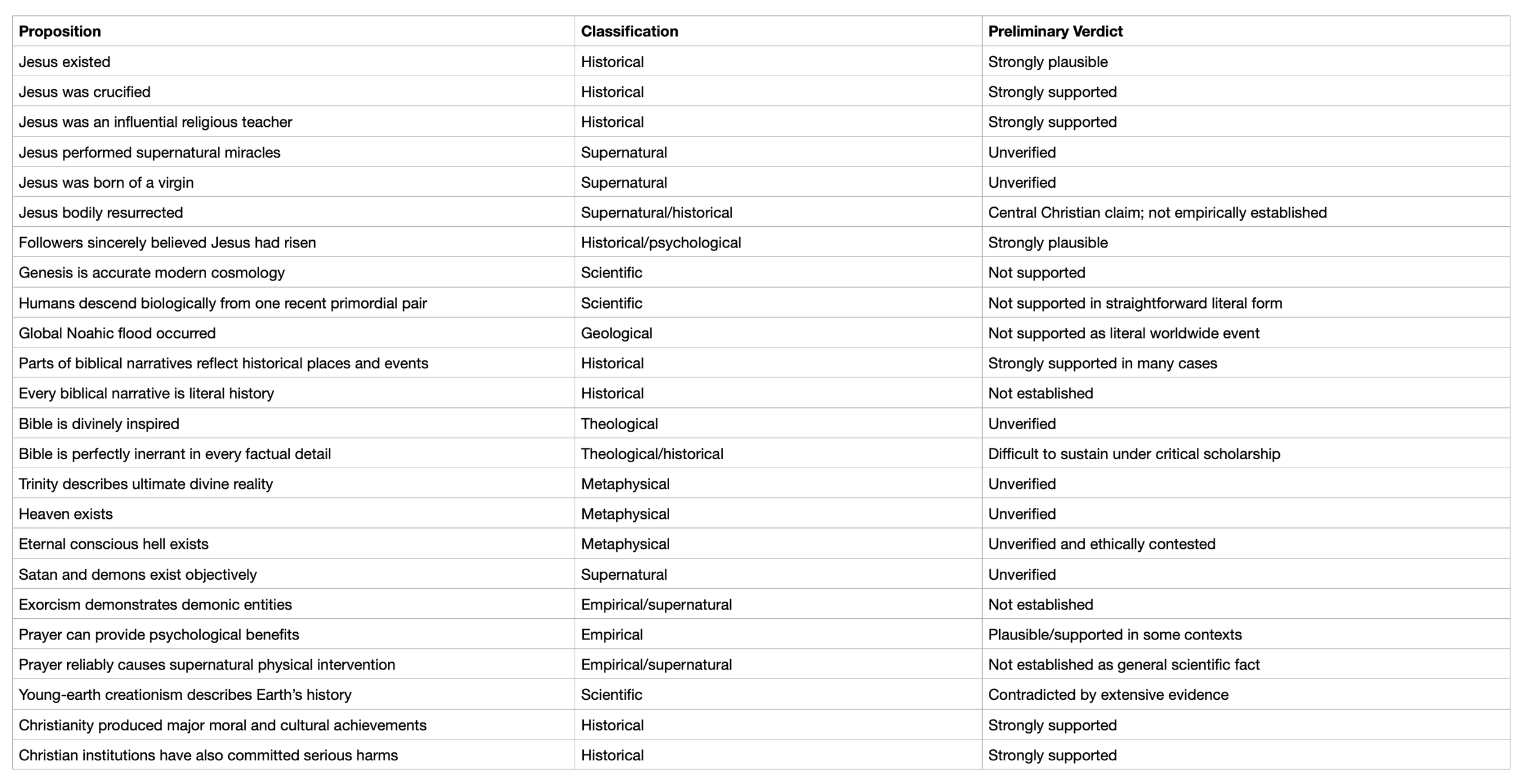
Every verdict remains revisable.
What Christianity Must Surrender
If Christianity wishes to remain intellectually credible in the modern world, it should surrender:
young-earth creationism presented as science,
biblical inerrancy treated as an escape from textual criticism,
the assumption that martyrdom proves truth,
the use of archaeology to smuggle in miracles,
supernatural explanations that displace medical care,
fear of historical-critical scholarship,
the idea that questioning scripture is itself immoral,
and
the belief that institutional authority guarantees divine correctness.
None of these are necessary for Christianity to survive.
What Christianity Should Preserve
Preserve:
the ethical seriousness.
the artistic inheritance.
the music.
the architecture.
the contemplative traditions.
the critique of hypocrisy.
the concern for the poor.
the language of forgiveness.
the existential confrontation with suffering.
the philosophical debates about personhood, morality and meaning.
the willingness of some Christian traditions to confess institutional wrongdoing.
And preserve the question at Christianity’s centre:
What would love demand?
That question remains powerful even for someone uncertain about theology.
Mahakali Judgment
Christianity is neither simply “true” nor simply “false.”
It is a mixture of:
historically plausible claims,
historically uncertain claims,
mythological and theological narratives,
unverified supernatural propositions,
powerful ethical ideas,
institutional developments,
and interpretations that sometimes collide directly with modern evidence.
Its strongest intellectual form is not biblical fundamentalism.
It is a Christianity capable of saying:
“The Bible contains human voices as well as sacred meaning.”
“My faith is not identical to scientific proof.”
“The historical Jesus and the theological Christ are related but analytically distinct.”
“The Resurrection is a matter of faith supported by historical argument, not a laboratory result.”
“Evolution does not threaten God.”
“The church can be wrong.”
“My interpretation can be wrong.”
“If evidence changes, I will reconsider.”
Such Christianity remains open to inquiry.
And anything genuinely true should survive inquiry.
The danger begins only when Christianity insists that protecting doctrine is more important than discovering reality.
Religious Epistemology Audit 02 — Christianity
Faith may transcend evidence. It must never impersonate evidence.
Nothing Is Above Inquiry.