Hinduism Under the Epistemic Microscope - Vedas, Upanishads, Bhagavad Gita, Epics, Puranas, Agamas, Tantra and the Question of What Is Actually True
Hinduism presents an unusual problem for anyone attempting to determine whether a religion is “true.”
There is no single Hindu Bible.
There is no universally binding creed.
There is no single founder.
There is no single historical moment when Hinduism appeared.
There is no single conception of God.
There is not even universal agreement that God is necessary.
What is today called Hinduism contains ritual traditions, philosophical systems, devotional movements, temple cultures, ascetic disciplines, mythology, metaphysics, yoga, tantra, folk religion and competing theories of reality accumulated across millennia.
A ruthless examination must therefore begin by rejecting the easiest mistake:
Hinduism cannot be audited as though it were one book making one coherent set of claims.
The Vedas are not the Puranas.
The Upanishads are not the Ramayana.
Advaita Vedanta is not Dvaita Vedanta.
Shaivism is not Vaishnavism.
Shaktism is not necessarily either.
Philosophical Hinduism is not identical to popular temple religion.
And modern claims that ancient India possessed nuclear weapons or advanced aircraft cannot automatically be attributed to ancient Hindu thinkers themselves.
We must separate the layers.
Only then can the real investigation begin.
I. What Exactly Are We Auditing?
A simplified textual map looks something like this:
Vedas
Rigveda
Samaveda
Yajurveda
Atharvaveda
followed by layers including:
Brahmanas
Aranyakas
Upanishads
followed historically by enormous bodies of literature including:
Mahabharata
Bhagavad Gita
Ramayana
Dharmashastra literature
Puranas
Agamas
Tantras
and the philosophical traditions associated with:
Nyaya,
Vaisheshika,
Samkhya,
Yoga,
Mimamsa,
Vedanta,
alongside numerous Shaiva, Shakta, Vaishnava and other traditions.
Even this map is drastically simplified.
The first verdict therefore arrives immediately:
“The Hindu scriptures say…” is often an intellectually inadequate sentence.
Which scripture?
From what period?
Which school?
Which recension?
Which commentator?
Literal or metaphorical?
Philosophical or ritual?
Pan-Hindu or sectarian?
Until those questions are answered, sweeping claims about “Hinduism” frequently tell us very little.
II. The Vedas: Revelation or Historical Literature?
Traditional Hindu classifications frequently describe the Vedas as shruti—“that which is heard”—giving them exceptional religious authority.
But religious authority and historical origin are separate questions.
From the standpoint of historical scholarship, the Vedas emerged through ancient human communities and were transmitted with extraordinary oral sophistication.
That oral preservation deserves admiration.
But preservation does not establish supernatural authorship.
A perfectly transmitted statement can still be wrong.
The epistemological question is therefore:
What evidence demonstrates that the Vedas originate from a supernatural source rather than human religious culture?
Tradition can answer:
Because the Vedas are shruti.
But that establishes what the tradition believes.
It does not independently establish divine origin.
The Vedas contain hymns, rituals, invocations, cosmological speculation and extraordinary poetic imagination.
Some passages display intellectual uncertainty rather than dogmatism.
That is important.
The famous speculative spirit of Vedic cosmology can sometimes appear remarkably comfortable with the possibility that ultimate origins may remain unknown.
That epistemic humility is arguably more intellectually durable than later attempts to make scripture omniscient.
III. The Upanishads: Hinduism Becomes Philosophically Dangerous
If the Puranas are easy targets for scepticism, the Upanishads are not.
Their strongest ideas cannot simply be defeated by pointing a telescope at the sky.
The Upanishadic traditions investigate questions such as:
What is consciousness?
What is the self?
What remains when ordinary identity is stripped away?
What is ultimate reality?
Is the distinction between observer and observed fundamental?
What does death mean?
What produces suffering and attachment?
These are legitimate philosophical questions.
Concepts such as Atman, Brahman, liberation and the relationship between consciousness and reality belong largely to metaphysics.
Science cannot simply announce:
“Brahman has been disproved.”
But neither can a Vedantin legitimately announce:
“Physics has proved Brahman.”
Both statements exceed what the evidence establishes.
The appropriate verdict for many Upanishadic propositions is therefore neither scientifically proven nor scientifically disproven.
It is:
Philosophically significant; metaphysically unresolved.
That is a much stronger intellectual position than fake scientific validation.
IV. Atman: Is There Really a Permanent Self?
Different Indian traditions disagree radically about this.
Many Hindu philosophies propose some form of enduring self.
Buddhism famously challenges permanent-self theories.
Modern neuroscience complicates the picture further by demonstrating how profoundly personality, memory, perception and identity depend upon brain function.
Damage the brain and personality can change.
Memory can disappear.
Perception can fragment.
Decision-making can alter.
This provides powerful evidence that much of what humans experience as “self” depends upon biological processes.
But does that prove no dimension of consciousness survives bodily death?
No.
It demonstrates dependence between ordinary conscious functioning and the brain.
The stronger metaphysical proposition remains unresolved.
Therefore:
Permanent Atman: unverified metaphysical proposition.
Not established science.
Not necessarily disproven.
V. Karma: One Word, Several Claims
“Karma” is frequently discussed as though it represents one proposition.
It does not.
Karma as ordinary causality
Actions have consequences.
Obviously true.
Karma as psychological causality
Repeated behaviour shapes character and habits.
Substantially plausible and often empirically defensible.
Karma as social causality
Cruel behaviour can damage relationships and reputation.
Again plausible.
Karma as cosmic moral accounting
The universe somehow ensures moral consequences beyond ordinary causal mechanisms.
Unverified.
Karma across reincarnations
Actions in one life influence conditions in subsequent lives.
Extraordinary metaphysical proposition requiring extraordinary evidence.
These categories should never be conflated.
The truth of ordinary consequences does not prove supernatural karmic administration.
VI. Reincarnation
Reincarnation is among Hinduism’s most important testable-adjacent propositions.
If consciousness or some persistent identity passes between bodies, evidence might conceivably appear.
Researchers have investigated alleged past-life memories and unusual cases, particularly involving children.
Such material deserves investigation rather than automatic ridicule.
But extraordinary anecdotes do not yet establish reincarnation as scientific consensus.
Alternative explanations must be considered:
information leakage,
parental reinforcement,
memory construction,
coincidence,
cultural expectation,
fraud,
selective reporting,
and methodological weaknesses.
The appropriate verdict remains:
Interesting research question; insufficient evidence for established fact.
That is not equivalent to saying reincarnation is impossible.
It means humanity has not earned certainty.
VII. Bhagavad Gita: Philosophy Inside a Battlefield
The Bhagavad Gita is among the most influential philosophical texts produced by Indian civilisation.
It explores:
duty,
action,
detachment,
selfhood,
devotion,
knowledge,
discipline,
mortality,
and liberation.
These ideas deserve philosophical examination independently of whether Krishna is literally God.
But the text also operates inside a war narrative.
That creates difficult moral questions.
When does duty justify violence?
Can religious duty override individual conscience?
Can obedience to cosmic order become a mechanism for legitimising warfare?
Does Krishna’s divine status immunise his instructions from moral criticism?
Mahakali Tribunal rejects such immunity.
A divine character must be subjected to the same ethical analysis as any other moral authority.
The Gita’s philosophical brilliance does not mean every interpretation of its ethics must be accepted.
Nor does ethical disagreement establish that the entire text is worthless.
Civilisational intelligence requires resisting both extremes.
VIII. Was Krishna Historical?
Several questions are frequently collapsed:
Did Krishna exist?
Did a historical person inspire Krishna traditions?
Did the Mahabharata preserve memories of historical conflicts?
Did Krishna perform miracles?
Was Krishna an incarnation of Vishnu?
Did Krishna reveal a cosmic form?
These are completely different propositions.
Historical evidence for some underlying people, places or conflicts would not automatically prove supernatural claims.
Archaeology establishing an ancient settlement associated with a tradition cannot establish divinity.
This principle is universal.
A historical Jesus would not automatically prove resurrection.
A historical Buddha would not prove rebirth.
A historical Muhammad would not prove revelation.
A historical Krishna would not prove avatarhood.
Historicity is not divinity.
IX. Ramayana: History, Epic or Both?
The Ramayana has shaped South and Southeast Asian civilisation enormously.
But cultural importance cannot settle historicity.
We must distinguish:
Was there an ancient ruler who contributed to the Rama tradition?
Could the epic preserve memories of historical geography?
Did political conflicts inspire portions of the narrative?
Did every event happen literally?
Did supernatural beings participate?
Could Hanuman physically perform the extraordinary feats attributed to him?
Did divine weapons operate as described?
Was Rama literally Vishnu incarnated?
These claims require different evidence.
The existence of locations associated with an epic does not prove every event within the epic.
London exists.
That does not make every event in a novel set in London historical.
Geographical correspondence is evidence of geographical knowledge—not automatic authentication of supernatural narrative.
X. Mahabharata: Historical Core Versus Sacred Expansion
The Mahabharata presents similar difficulties.
An ancient conflict may conceivably lie somewhere behind parts of the epic tradition.
But the text underwent development across long periods.
Separating potential historical memory from theological and literary expansion requires textual criticism, archaeology and historical analysis.
Claims concerning enormous armies, supernatural interventions, divine weapons and extraordinary events should not automatically receive historical status merely because some geographical references correspond with real places.
Again:
historical substrate does not authenticate every narrative layer.
XI. Were Astras Nuclear Weapons?
This deserves a direct verdict.
Modern popular mythology frequently claims that descriptions of astras prove ancient India possessed nuclear weapons.
The argument usually works through resemblance.
Bright explosions.
Terrible weapons.
Heat.
Destruction.
Therefore:
nuclear warfare.
But metaphorical resemblance is not technological evidence.
To establish ancient nuclear weapons, we would expect some combination of:
material evidence,
technological infrastructure,
mining systems,
specialised metallurgy,
engineering knowledge,
production facilities,
physical residues,
technical documentation,
and archaeological signatures compatible with nuclear technology.
Poetic descriptions of extraordinary weapons do not meet that burden.
Verdict: unsupported as established historical technology.
Ancient Indian literature does not become less magnificent because it did not contain twentieth-century nuclear engineering.
XII. Vimanas: Ancient Aerospace Engineering?
The same problem appears with flying vehicles.
Human beings imagined flight long before achieving powered aviation.
Flying chariots and supernatural vehicles appear in multiple mythological traditions.
A description of something flying does not establish an aerospace industry.
Actual aircraft require:
aerodynamics,
propulsion,
materials engineering,
structural design,
control systems,
manufacturing,
energy systems,
testing,
maintenance,
and industrial infrastructure.
If ancient India possessed technologically advanced aviation, the archaeological consequences would be extraordinary.
Claims of functional ancient aerospace technology therefore require far more than interpreting mythological vehicles through modern terminology.
Vimanas as sacred or mythological vehicles: clearly present in literature.
Vimanas as demonstrated evidence of advanced ancient aerospace engineering: unsupported.
XIII. Puranic Cosmology
Here Hindu literalism encounters some of its greatest difficulties.
Puranic traditions contain enormously elaborate accounts of:
cosmic cycles,
worlds,
divine realms,
extraordinary beings,
genealogies,
vast timescales,
sacred geography,
creation,
destruction,
and rebirth of universes.
Some defenders point out that enormous Hindu timescales are far more expansive than young-earth chronologies.
True.
But possessing enormous numbers does not automatically produce accurate cosmology.
Modern cosmology depends upon observational evidence, mathematics, astrophysics and testable models.
Similarity between an ancient number and a modern timescale is not enough.
When Puranic cosmography conflicts with well-established astronomy, literal cosmography should yield to evidence.
The alternative is to treat the material symbolically, theologically or mythologically.
That is intellectually legitimate.
Calling it modern astrophysics is not.
XIV. Yugas
Traditional Hindu chronology describes enormous cycles of ages.
Modern attempts sometimes try to correlate these directly with astronomical or geological periods.
Again the methodological question is:
Were those correlations clearly derivable before modern discoveries?
Or were ancient categories retrofitted afterward?
Without independent predictive success, the Yuga framework remains principally a religious cosmological system rather than established scientific chronology.
XV. Avatars and Evolution
One popular claim argues:
Matsya resembles aquatic life.
Kurma resembles amphibious development.
Varaha resembles terrestrial mammals.
Narasimha resembles transitional forms.
Vamana resembles early humans.
Therefore the Dashavatara predicted Darwinian evolution.
It is an imaginative comparison.
It is not evolutionary biology.
Evolution requires concepts including:
heredity,
variation,
selection,
population change,
common descent,
genetics,
and deep time.
A sequence of mythological forms that can retrospectively be arranged to resemble evolutionary progression does not establish anticipation of Darwin’s theory.
The comparison may remain philosophically or pedagogically interesting.
It should not be advertised as scientific discovery.
XVI. Astrology
Astrology occupies an influential position across Indian culture.
But astrology makes propositions capable of empirical investigation.
If planetary configurations reliably predict personality, compatibility or future events beyond chance, controlled studies should be able to detect the effect.
The appropriate scientific question is not:
“Is astrology ancient?”
It is:
Does astrology reliably predict outcomes under controlled conditions?
Antiquity cannot substitute for predictive performance.
Where strong reproducible predictive evidence is absent, confidence should fall accordingly.
XVII. Ayurveda: Do Not Make the Opposite Mistake
Ayurveda requires a more nuanced audit.
Traditional medical systems can contain:
useful observations,
effective substances,
ineffective treatments,
incorrect theories,
cultural practices,
and genuine medical discoveries simultaneously.
Therefore:
Ayurveda is ancient, therefore everything works
is bad reasoning.
But so is:
Ayurveda is ancient, therefore nothing works.
Individual interventions should be tested individually.
Does the treatment outperform placebo or standard care?
What are the active compounds?
What dosage is effective?
What toxicity exists?
What interactions occur?
Traditional origin neither proves nor disproves efficacy.
Medicine should ultimately be judged by outcomes and evidence.
XVIII. Yoga
Yoga provides perhaps the clearest example of why Hinduism cannot simply be classified as “true” or “false.”
Certain physical, respiratory and contemplative practices can be empirically investigated.
Some may produce measurable benefits.
That does not prove every metaphysical framework historically associated with yoga.
If meditation reduces stress, meditation reduced stress.
It does not follow that chakras have thereby been established as literal anatomical structures.
If breathing practices influence autonomic processes, that demonstrates physiology.
It does not automatically prove prana as a separate physical energy.
Effectiveness of practice does not authenticate every explanatory theory attached to the practice.
XIX. Chakras, Nadis and Kundalini
People can experience extremely powerful bodily and psychological phenomena during meditation, breathwork, ritual and altered states.
Those experiences deserve serious investigation.
But we must distinguish:
phenomenology
from
anatomy.
Someone experiencing energy rising through their body demonstrates that they experienced a sensation.
It does not independently establish invisible anatomical channels.
Traditional maps may function as sophisticated phenomenological models.
Whether they correspond to independently measurable physical structures remains another question.
The verdict should therefore remain proportional to evidence.
XX. Tantra
“Tantra” is another term almost destroyed by oversimplification.
There is no single Tantra.
Tantric traditions include enormous varieties of:
ritual,
mantra,
visualisation,
deity practice,
philosophy,
yoga,
initiation,
subtle-body models,
sexual symbolism,
temple practice,
and metaphysics.
Some tantric methods can be studied psychologically.
Some claims remain metaphysical.
Some historical practices can be investigated anthropologically.
Some modern “Tantric” claims are recent inventions wearing ancient branding.
Each proposition requires separate examination.
XXI. Shiva, Vishnu, Devi and the Problem of Ontology
What does it mean to ask:
Does Shiva exist?
There are several possible propositions.
Shiva as a historical development in Indian religious culture?
Clearly investigable historically.
Shiva as mythology?
Clearly present.
Shiva as archetype?
Philosophically and psychologically discussable.
Shiva as consciousness itself?
Metaphysical proposition.
Shiva as a literally existing supernatural person capable of intervening physically in human affairs?
Empirical-adjacent supernatural claim requiring evidence.
Likewise for:
Vishnu.
Lakshmi.
Kali.
Durga.
Ganesha.
Hanuman.
Saraswati.
Krishna.
Rama.
A sophisticated audit cannot declare “Shiva exists” or “Shiva doesn’t exist” without first defining which Shiva proposition is being discussed.
XXII. Divine Experiences
Millions of Hindus report experiences interpreted through religious frameworks.
Visions.
Dreams.
Possession.
Darshan.
Synchronicities.
Answered prayers.
Meditative states.
Apparent divine communication.
Such reports should neither be mocked nor automatically accepted as supernatural evidence.
The experience may be genuine while the explanation remains uncertain.
Potential explanatory domains include:
neuroscience,
psychology,
cultural conditioning,
expectation,
dissociation,
altered states,
ritual psychology,
sleep phenomena,
and possibilities not presently understood.
The scientifically responsible verdict is sometimes:
Experience credible; cause unresolved.
XXIII. Gurus Are Not Evidence
Hindu traditions have produced exceptional philosophers and spiritual teachers.
They have also produced charlatans.
Charisma cannot authenticate metaphysics.
Neither can:
robes,
Sanskrit vocabulary,
lineage,
followers,
wealth,
ascetic appearance,
miracle stories,
celebrity endorsement,
or claims of enlightenment.
The correct question remains:
What exactly is being claimed, and what evidence supports it?
A guru saying something does not make it true.
A million disciples repeating it does not transform repetition into evidence.
XXIV. Hinduism’s Greatest Epistemic Strength
Paradoxically, Hinduism contains resources for surviving this entire audit.
Its philosophical diversity is enormous.
Indian civilisation produced traditions of argument, scepticism, logic, metaphysical disagreement and even explicitly materialist criticism.
Hindu thought does not collapse merely because one Purana contains inaccurate cosmology.
Nor does Hindu spirituality disappear because a miracle story lacks evidence.
A tradition capable of treating mythology symbolically, philosophy critically and practices experimentally can evolve.
That flexibility can become an enormous strength.
XXV. Hinduism’s Greatest Epistemic Weakness
The same flexibility can become a weakness.
When evidence contradicts a literal claim, the claim can suddenly become metaphor.
When science discovers something, an ancient verse can suddenly be declared to have predicted it.
When two texts conflict, they can be assigned different “levels of truth.”
When mythology appears implausible, symbolism rescues it.
When symbolism becomes politically inconvenient, literalism can return.
This creates the danger of infinite interpretive elasticity.
A worldview capable of explaining every possible outcome risks predicting nothing.
Hinduism’s intellectual future therefore depends partly upon distinguishing legitimate pluralism from unfalsifiable reinterpretation.
The Preliminary Mahakali Ledger
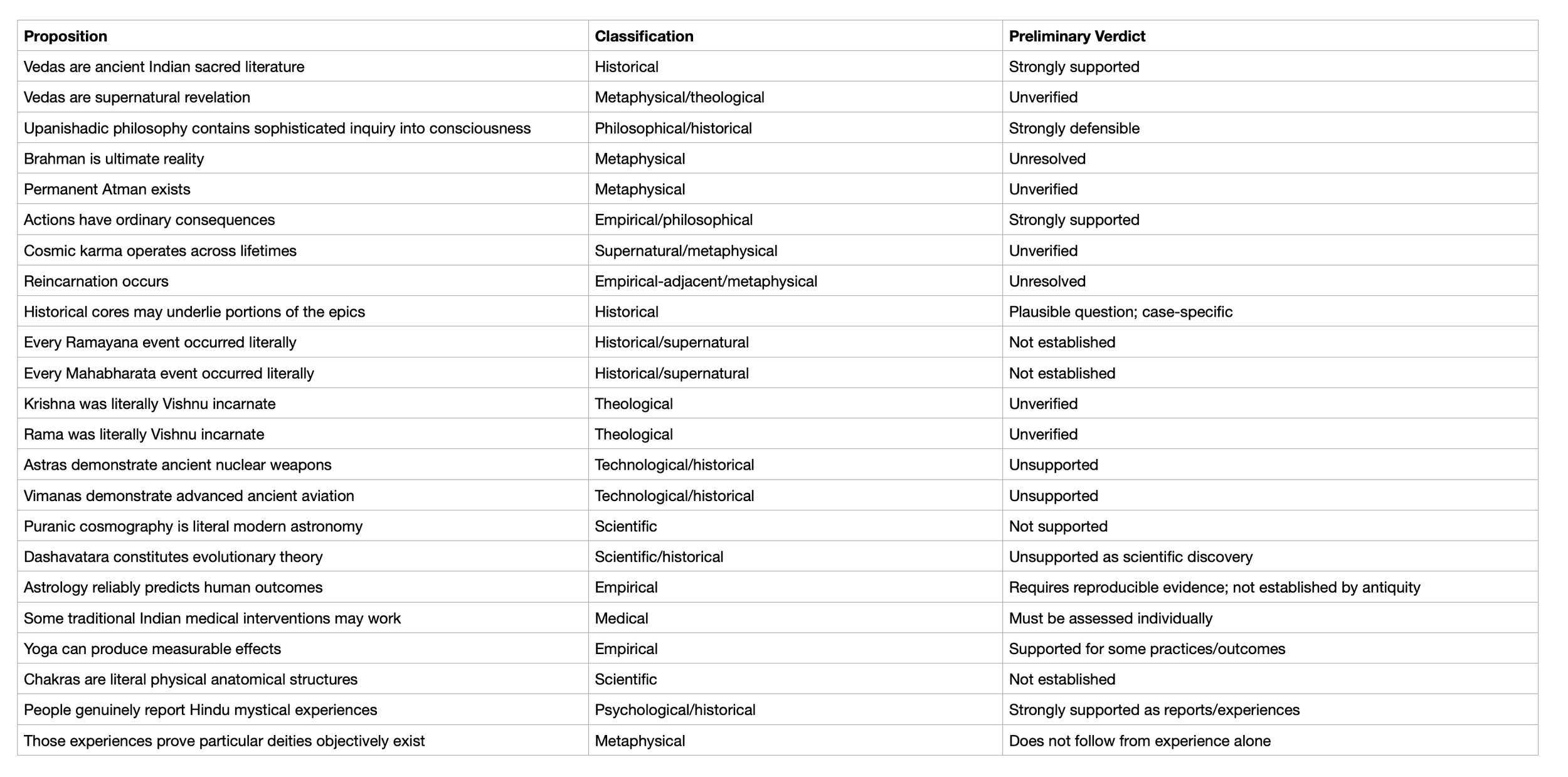
This ledger is provisional.
Every verdict remains open to stronger evidence.
The Verdict on Hinduism
So—is Hinduism true?
The question remains too crude.
A more accurate verdict is:
Hinduism contains propositions ranging from empirically useful practices and profound philosophy to unverified metaphysics, mythology and claims that become indefensible when presented as established modern science.
That is neither condemnation nor endorsement.
It is classification.
The Upanishads do not become worthless because Puranic cosmology is not astrophysics.
Yoga does not become useless because chakras remain scientifically unestablished as literal anatomy.
The Mahabharata does not cease being great literature because divine weapons are not evidence of nuclear engineering.
Kali does not lose symbolic power because her supernatural existence cannot presently be scientifically demonstrated.
And ancient Indian civilisation does not need imaginary aircraft, nuclear bombs or quantum physicists to be extraordinary.
Its genuine achievements are impressive enough.
What Hinduism Must Surrender
If Hindu traditions wish to coexist seriously with modern epistemology, several habits should be abandoned:
Retrofitting modern scientific discoveries into ambiguous ancient verses.
Treating mythology as archaeology whenever politically convenient.
Using antiquity as evidence of truth.
Confusing spiritual experience with objective verification.
Protecting gurus from scrutiny.
Declaring questioning disrespectful.
Treating scripture as automatically superior to observation.
None of these practices is necessary for Hindu philosophy to survive.
What Hinduism Should Preserve
Preserve:
the philosophical arguments.
the poetry.
the music.
the architecture.
the meditation traditions.
the festivals.
the iconography.
the metaphysical experimentation.
the intellectual pluralism.
the debates.
the stories.
the art.
the languages.
the civilisational memory.
the willingness of some Indian traditions to ask astonishingly difficult questions about consciousness and existence.
A civilisation does not honour its ancestors by pretending they knew everything.
It honours them by continuing their search.
Mahakali Judgment
Hinduism does not need immunity from criticism.
It needs something better:
the freedom to evolve.
The future Hindu intellectual should be capable of saying:
“I revere the Upanishads without pretending they are neuroscience textbooks.”
“I worship Kali without claiming that my private religious experience constitutes scientific proof.”
“I read the Mahabharata without pretending every supernatural event is documented history.”
“I practice yoga while allowing medicine to determine which health claims actually work.”
“I can love an ancient civilisation without inventing technologies it did not possess.”
And perhaps most importantly:
“If evidence contradicts my interpretation, I will change my interpretation.”
That would not destroy Hinduism.
It might produce one of its most intellectually sophisticated forms yet.
Because the ultimate choice facing Hindu civilisation is not:
Faith or atheism.
It is:
Dogma or inquiry.
Mythology can survive inquiry.
Philosophy can flourish through inquiry.
Spirituality can coexist with inquiry.
Culture can become richer through inquiry.
Only false certainty needs protection from it.
Mahakali Tribunal
Religious Epistemology Audit 01 — Hinduism
Revere what deserves reverence. Question what demands belief. Test what makes claims about reality.
Nothing Is Above Inquiry.