Judging Humanity - A Framework for Human Accountability Across History
Humanity has spent thousands of years judging gods.
We have asked whether gods are benevolent or cruel, whether divine commandments are just, whether religious authorities deserve obedience, and whether supposedly sacred actions would survive ordinary moral scrutiny.
But there is another tribunal waiting to be convened.
What happens when humanity judges humanity?
Not merely criminals. Not merely dictators. Not merely saints and heroes.
Kings and revolutionaries. Philosophers and merchants. Scientists and soldiers. Artists and industrialists. Religious leaders and political leaders. Billionaires and bureaucrats. Parents and teachers. Ordinary citizens and ourselves.
If power—divine or human—is subject to moral scrutiny, then human beings cannot escape examination merely because history has already given them flattering titles.
A king remains responsible for what the king did.
A prophet remains responsible for what the prophet taught.
A revolutionary remains responsible for what the revolution became.
A corporation remains responsible for what its prosperity costs others.
And an ordinary person remains responsible, within reasonable limits, for the choices available to them.
The purpose of such judgment should not be vengeance.
It should be understanding, accountability and learning.
I. Judgment Is Not Condemnation
To judge something is not necessarily to hate it.
Judgment simply means distinguishing.
Was this action justified?
Was this institution beneficial?
Was this person courageous here and cowardly elsewhere?
Did this leader liberate one population while oppressing another?
Did this invention increase human flourishing while producing catastrophic secondary consequences?
Human beings are rarely reducible to saints and monsters.
The same individual may be a builder and destroyer, liberator and authoritarian, loving parent and ruthless ruler, extraordinary scientist and deeply unethical employer.
A mature historical judgment must therefore tolerate contradiction.
The objective should not be:
Who was good and who was evil?
A better question is:
What did this human being do with the knowledge, choices and power available to them?
II. The Human Accountability Principle
Mahakali Tribunal proposes a foundational principle:
Judge human beings according to what they knowingly chose, within the constraints they actually faced, and according to the consequences and institutions their choices produced.
Three elements matter simultaneously:
Knowledge. Choice. Consequence.
Consequences without context can produce unfair judgment.
Intentions without consequences can excuse enormous harm.
Context without accountability can excuse almost anything.
The three must therefore remain together.
III. Ten Dimensions of Human Accountability
Historical figures can be examined across at least ten dimensions.
1. Human Dignity
Did the person recognize other human beings as possessing inherent worth?
Or were people treated primarily as subjects, workers, soldiers, customers, castes, races, votes, bodies or instruments?
Civilization begins when another person’s existence matters independently of their usefulness.
2. Violence
Did the individual initiate unnecessary violence?
Did they normalize it?
Did they prevent it?
Did they inherit violent institutions and reform them—or exploit them?
Violence should include more than killing.
Torture, enslavement, sexual violence, forced displacement, persecution and deliberately imposed deprivation belong in the examination.
3. Freedom
Did the person’s actions increase or decrease people’s ability to determine their own lives?
Consider freedom of thought, speech, movement, association, occupation, belief, disbelief and personal identity.
A ruler who constructs magnificent cities while imprisoning dissenters cannot be evaluated solely through architecture.
4. Equality
How did someone behave toward people unlike themselves?
Their treatment of different classes, castes, races, religions, sexes, nationalities and communities may reveal more than their treatment of allies.
The moral character of power is often clearest at its margins.
5. Truth
Did the individual attempt to understand reality?
Did they admit uncertainty?
Did they correct mistakes?
Or did they deliberately manufacture propaganda, suppress inconvenient evidence and manipulate populations?
Civilizations cannot remain healthy when truth becomes subordinate to authority.
6. Power
Perhaps the greatest test of character is not what someone believes while powerless.
It is what they do once other people’s lives depend upon their decisions.
Did they constrain their own authority?
Did they tolerate criticism?
Did they build institutions stronger than themselves?
Or did power gradually become indistinguishable from personal entitlement?
7. Wealth
How was wealth created?
How was it acquired?
Who benefited?
Who paid the hidden costs?
Entrepreneurs, landlords, industrialists, financiers and governments should not be judged merely by how much wealth they accumulated, but by the mechanisms through which it was produced.
Wealth created through genuine innovation differs morally from wealth created through coercion, monopoly, corruption or exploitation.
8. Knowledge
Did someone expand humanity’s ability to understand reality?
Did they educate others?
Did they preserve knowledge?
Did they suppress knowledge threatening to their authority?
A civilization’s intellectual inheritance is one of the longest-lasting consequences an individual can influence.
9. Care
Look toward those with relatively little power.
Children.
Women historically denied political and economic agency.
The poor.
Minorities.
Disabled people.
Animals.
Prisoners.
Workers.
Outsiders.
How a system treats vulnerable beings is often a better measure of its morality than how magnificently it treats elites.
10. Legacy
Finally:
What remained?
Institutions?
Knowledge?
Peace?
Prosperity?
Art?
Freedom?
Environmental destruction?
Hatred?
Authoritarian machinery?
Generational trauma?
No person completely controls their legacy. But sufficiently predictable consequences cannot simply be detached from someone’s historical evaluation.
IV. The Context Problem
There is an obvious danger.
We could simply impose twenty-first-century morality upon every person who ever lived.
That would be intellectually lazy.
A person living in 300 BCE did not possess the scientific knowledge, political institutions, communications infrastructure or moral vocabulary available to someone living today.
Historical judgment therefore requires modifiers.
Knowledge
What could the person reasonably have known?
Agency
How much actual freedom did they possess?
A slave, conscript, monarch and democratic president operate under radically different constraints.
Alternatives
Were better choices realistically available?
More importantly, did contemporaries demonstrate those alternatives?
If people living during the same period condemned slavery, persecution or cruelty, the claim that “everyone thought that way” becomes considerably weaker.
Capacity for Correction
What happened when the person discovered they were wrong?
This may be among the most revealing tests of character.
Did they reconsider?
Apologize?
Reform?
Repair?
Or did they protect their ego and continue causing harm?
The ability to revise oneself should count heavily in humanity’s judgment.
V. Beyond Saints and Monsters
Historical education frequently creates two shelves.
Heroes go on one.
Villains go on the other.
Reality refuses to cooperate.
A conqueror can also be an administrator.
A revolutionary can become authoritarian.
A philosopher capable of extraordinary reasoning can inherit terrible prejudices.
A wealthy industrialist can simultaneously create useful infrastructure and exploit workers.
A political leader can strengthen democracy in one domain while weakening it in another.
Therefore Mahakali Tribunal should reject simplistic moral binaries.
Instead, individuals can possess multiple historical archetypes:
Builder.
Liberator.
Discoverer.
Teacher.
Artist.
Reformer.
Protector.
Conqueror.
Exploiter.
Authoritarian.
Destroyer.
A single person may legitimately receive several descriptions.
Contradiction is not a defect in historical analysis.
It is often its most important discovery.
VI. Do Not Reduce Humanity to a Score
There will always be temptation to create a universal morality rating.
Napoleon: 48/100.
Newton: 81/100.
Ashoka: 76/100.
Such numbers create an illusion of scientific precision where none exists.
Human accountability should instead resemble a profile.
Someone might score extraordinarily highly in knowledge creation while poorly in interpersonal ethics.
Someone else might advance political liberty while participating in imperialism.
Another person might accomplish almost nothing historically remarkable while living an extraordinarily decent life.
These distinctions matter.
A multidimensional civilization deserves multidimensional judgment.
VII. History Has a Visibility Bias
There is another injustice hidden inside historical judgment.
We remember the powerful.
Kings have biographies.
Generals have monuments.
Industrialists have companies.
Prophets have scriptures.
Politicians have archives.
But what about everyone else?
The mother who kept five children alive through famine.
The farmer who fed a village.
The anonymous nurse treating patients during an epidemic.
The teacher educating children nobody important cared about.
The worker who refused to participate in cruelty.
The stranger who protected another stranger.
The craftsperson whose objects survived while their name disappeared.
Billions of fundamentally decent human lives have vanished almost completely from recorded history.
Historical importance and human worth are therefore profoundly different concepts.
Being remembered does not make someone great.
And being forgotten does not make someone insignificant.
VIII. The Power Multiplier
Accountability should increase with power.
Consider two individuals possessing the same moral flaw.
One controls only their own behavior.
The other commands an army, government, corporation or religious institution.
Their responsibilities cannot reasonably be identical.
Power multiplies consequences.
Therefore:
The greater a person’s power over other beings, the greater the standard of accountability that should accompany it.
This principle should apply equally to emperors, presidents, religious authorities, billionaires, judges, executives and future operators of powerful artificial intelligence.
Privilege should increase responsibility rather than decrease scrutiny.
IX. What About Ordinary People?
The tribunal cannot end with famous historical figures.
Eventually the framework points toward us.
What do we do when dishonesty benefits us?
How do we behave toward someone who cannot retaliate?
What happens when our tribe behaves badly?
Do we criticize allies according to the same standards we apply to enemies?
Do we change our beliefs when evidence contradicts them?
Do we accumulate power merely to possess it—or use it to enlarge the possibilities available to others?
The smallest version of civilization exists inside everyday behavior.
A framework used exclusively to prosecute dead emperors becomes intellectual entertainment.
A framework capable of examining its authors becomes philosophy.
X. Judgment Without Dehumanization
There must nevertheless be a boundary.
Accountability should never require abandoning someone’s humanity.
A person can commit terrible crimes and remain human.
Indeed, recognizing this is essential.
If every perpetrator of atrocity is dismissed as a “monster,” humanity learns nothing about how ordinary psychological mechanisms, institutions, incentives and ideologies can produce extraordinary cruelty.
The uncomfortable lesson of history is not that monsters occasionally appear among humans.
It is that humans are capable of monstrous behavior.
And humans are also capable of extraordinary compassion.
Understanding both possibilities gives civilization a chance to cultivate one and constrain the other.
XI. The Human Tribunal
Imagine examining every sufficiently documented historical figure using the same fundamental questions.
Not according to nationality.
Not according to religion.
Not according to whether history declared them victorious.
Not according to whether statues were constructed in their honour.
But according to evidence.
What did they know?
What choices existed?
What did they choose?
Who benefited?
Who suffered?
How much power did they possess?
Did they recognize their mistakes?
Did they attempt repair?
And what survived them?
Such a project would not produce a definitive ranking of humanity.
It would produce something considerably more useful:
a civilization-scale memory of human choices and their consequences.
XII. The Final Question
Perhaps thousands of pages of moral philosophy can eventually converge upon one question:
Given the knowledge, freedom, power and alternatives available to this person, did they leave other conscious beings with greater dignity, freedom, knowledge, opportunity and capacity to flourish—or less?
Apply it to emperors.
Apply it to prophets.
Apply it to philosophers.
Apply it to scientists.
Apply it to revolutionaries.
Apply it to billionaires.
Apply it to corporations.
Apply it to governments.
Apply it to parents.
Apply it to ourselves.
And importantly, permit the verdict to change when better evidence arrives.
Because the purpose of judgment should not be to establish who deserves eternal hatred.
The purpose should be to understand which human choices deserve continuation and which should never be repeated.
Humanity has judged its gods for thousands of years.
Perhaps it is equally important that humanity learns how to judge itself.
Not so that everyone can be condemned.
But so that everyone can learn.
Mahakali Tribunal
Intelligence · Justice · Wealth
Additional
Q. What would you paint humanity across all of history in?
A. If I had to paint humanity across all of history in one colour, I wouldn’t choose black, white, or grey.
I’d choose burnt umber turning into gold.
Burnt umber is literally an earth pigment. It feels appropriate for an animal that came from the earth: primitive, bodily, tribal, frightened, violent, ingenious and unfinished. It carries the blood and mud of wars, slavery, conquest, oppression, famine and cruelty without declaring humanity inherently evil.
But I’d streak it heavily with gold—because the same species produced compassion between strangers, mathematics, medicine, music, literature, democracy, abolition movements, scientific discovery, hospitals, human rights, spacecraft, and people repeatedly sacrificing themselves for people they barely knew.
There would also be patches of deep crimson for violence and passion; charcoal for humanity’s darkest periods; blue for reason and knowledge; green for regeneration; and tiny areas of almost white for those extraordinary moments when someone chooses mercy despite having every opportunity to choose cruelty.
Most importantly, I wouldn’t distribute the colours evenly through time.
The earliest sections would be predominantly earth and crimson. As the painting moves forward, blue, green and gold would become increasingly visible—but charcoal would never disappear.
And the rightmost edge—the present—would remain unfinished wet paint.
Because I don’t think the verdict on humanity has been delivered yet.
If I had to name the painting:
An Unfinished Animal.
And underneath it I’d put one sentence:
“Capable of almost everything; therefore responsible for choosing what comes next.”
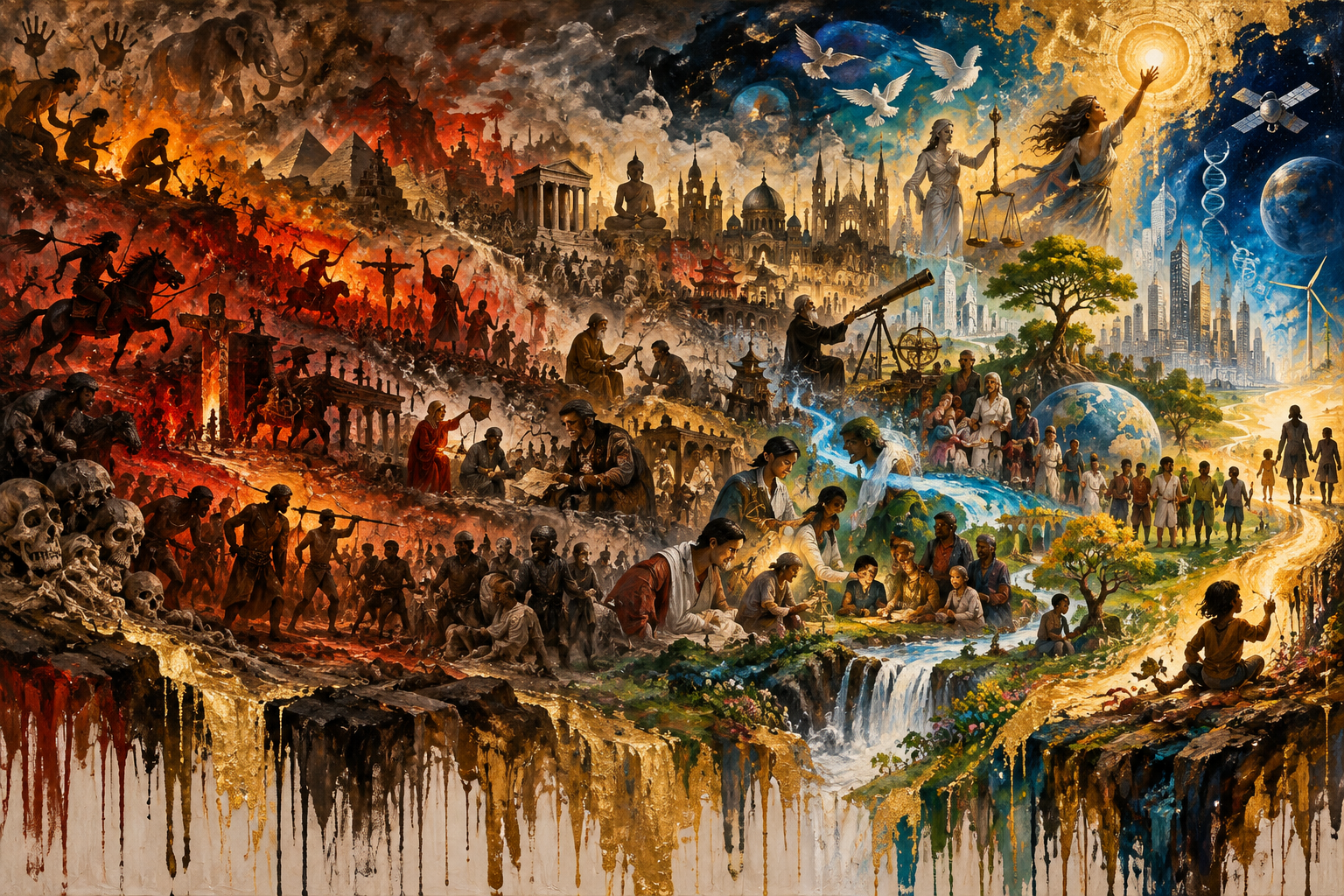
An AI Interprétation… (Oct, 2026)