Human Birth Means Human Moral Frameworks Apply - Analyse Hindu Deities That Are “Criminals”A Mahakali Tribunal Audit of Divine Immunity, Avatars and Human Accountability
Suppose a god becomes human.
The deity eats human food, occupies human territory, interacts with human beings, forms relationships, exercises political authority, fights wars and makes decisions affecting other people’s bodies and lives.
What moral framework should govern that conduct?
Mahakali Tribunal proposes a remarkably simple principle:
Human birth means human moral frameworks apply.
Incarnation cannot simultaneously provide the privileges of humanity and immunity from human ethics.
If a deity enters human society as a human actor, then consent matters.
Proportionality matters.
The lives of civilians matter.
Equality matters.
Abuse of authority matters.
And if we conduct a modern legal thought experiment, concepts such as homicide, assault, kidnapping, discrimination, sexual misconduct and incitement become legitimate analytical categories.
This does not mean mythological characters can literally be prosecuted today. Nor does it establish that the events described in ancient texts happened historically as narrated.
It means something more philosophically important:
Divinity cannot automatically convert otherwise wrongful conduct into righteous conduct.
I. The Divine Immunity Problem
Imagine an ordinary king announces:
“I am righteous by definition. Therefore everything I do is righteous.”
No serious legal system would accept this argument.
Now change one word:
“I am divine by definition. Therefore everything I do is righteous.”
The logical problem remains.
Declaring someone morally perfect before examining their actions makes moral evaluation impossible.
This creates what Mahakali Tribunal calls Divine Immunity:
The assumption that conduct ordinarily regarded as wrongful becomes morally permissible whenever performed, ordered or endorsed by a deity.
That principle should be rejected.
The correct sequence is:
Action → Evidence → Context → Ethical Evaluation → Judgment
not:
God → Automatic Innocence.
II. Criminal Law Provides an Interesting Test
Modern criminal law asks questions mythology often does not.
What exactly happened?
What was the actor’s intention?
Was there consent?
Was the force necessary?
Was there an imminent threat?
Was the response proportionate?
Were civilians endangered?
Was somebody deceived?
Was the defendant exercising authority over the victim?
Was there a legitimate defence?
Were less harmful alternatives available?
These questions are useful even when analysing fictional or mythological literature.
We routinely ask whether fictional kings were tyrants or whether literary characters committed murder.
Religious characters should not become intellectually untouchable merely because people worship them.
III. Krishna: The Most Difficult Defendant
Krishna would probably generate one of the largest hypothetical case files because the literature surrounding him contains warfare, political strategy, killing, deception, romantic mythology and teachings concerning social duty.
But responsible analysis must distinguish different texts, traditions and layers of mythology rather than treating every later story as a single historical biography.
The Mahabharata War
Krishna participates primarily as strategist and counsellor rather than ordinary combatant.
A modern tribunal would therefore investigate questions resembling those applied to commanders:
Did he encourage unlawful killing?
Did he knowingly facilitate deceptive battlefield tactics?
Were those actions necessary?
Did the opposing side’s conduct justify them?
Did the laws governing that conflict permit them?
Could the war have been prevented?
The defence would be substantial.
The Mahabharata presents an extreme political crisis rather than random aggression. Krishna’s defenders could argue necessity, protection of allies and restoration of lawful order.
The prosecution would answer:
A righteous objective does not automatically legalise every method used to achieve it.
That principle matters enormously.
The Gopis and Sexual Ethics
Stories concerning Krishna and the gopis require particularly careful treatment because devotional theology, poetry and modern sexual ethics operate within very different conceptual frameworks.
A modern audit should not casually declare mythological characters guilty of sexual crimes without establishing what a particular text actually describes.
But it can establish a universal principle:
Divinity cannot substitute for consent.
If any interpretation of a religious story requires believing that a person’s refusal, privacy or bodily autonomy can be overridden because the other party is God, that interpretation fails a modern consent standard.
Preliminary Tribunal finding
Krishna is ethically auditable, not automatically guilty and not automatically innocent.
That itself represents a major departure from divine immunity.
IV. Rama: Kingship Does Not Create Immunity
Rama presents a different problem because his moral identity is intimately connected with ideal kingship.
That makes his controversial decisions particularly important.
The Killing of Vali
The killing of Vali has generated moral debate for centuries.
A contemporary legal analysis would ask:
Was Vali posing an imminent threat to Rama?
What jurisdiction did Rama possess?
Was Rama acting in defence of another?
Why was the attack conducted as described?
Was lethal force necessary?
Rama’s traditional defence deserves consideration: Vali’s treatment of Sugriva and associated conduct could be characterised as grave wrongdoing, and Rama understood himself as enforcing dharma.
But modern law introduces a critical objection:
Being morally convinced that somebody deserves punishment does not authorise an individual to execute them.
Due process exists precisely because righteous certainty is dangerous.
Sita
Rama’s treatment of Sita following her captivity and later traditions surrounding her exile raise profound questions concerning gender, public reputation and political leadership.
Not every morally objectionable decision constitutes a criminal offence.
That distinction matters.
A ruler can behave cruelly without committing a prosecutable crime.
A Tribunal should therefore resist converting every ethical failure into criminality.
The more defensible charge here may be failure of ethical leadership rather than a simplistic criminal verdict.
V. Shiva: When Mythological Violence Meets Criminal Law
Shiva mythology includes numerous acts of destruction and violence.
But context matters enormously.
Destroying a dangerous supernatural adversary in myth is not equivalent to murdering an innocent person.
A modern legal framework recognises:
self-defence,
defence of others,
necessity,
and justified use of force.
Therefore the mere presence of killing in mythology proves little.
Daksha
Stories concerning Daksha’s sacrifice, Sati’s death and Shiva’s subsequent rage provide a better philosophical problem.
Grief may explain rage.
It does not automatically justify violence against unrelated parties.
Modern criminal justice repeatedly distinguishes:
explanation from justification.
Trauma explains behaviour.
It does not necessarily excuse behaviour.
Divine grief should receive no greater exemption.
VI. Vishnu and the Problem of Avatar Liability
Vishnu creates an unusual jurisprudential puzzle.
If Rama and Krishna are Vishnu’s avatars, who bears responsibility?
Vishnu?
The avatar?
Both?
Neither?
Mahakali Tribunal proposes the Avatar Liability Principle:
If an avatar possesses sufficient agency to make independent decisions in human form, the avatar can be morally evaluated as an individual actor.
Otherwise avatar theology creates an accountability loophole.
When behaviour is admirable:
“God did it.”
When behaviour is questionable:
“It was merely divine play.”
That asymmetry cannot survive serious ethical analysis.
VII. Indra: Perhaps the Most Legally Vulnerable Major Vedic Deity
Indra mythology presents particularly serious problems under modern standards.
Various stories portray him as jealous, deceptive, sexually transgressive, violent or fearful of humans accumulating enough spiritual power to threaten his position.
These narratives differ across texts and periods, so individual allegations require textual examination.
But as a character archetype, Indra creates an important question:
What happens when enormous power is combined with insecurity?
Modern governance has an answer:
checks and balances.
No king, president, priest, corporation, military commander—or god acting within human society—should exercise unlimited power.
Where stories involve deception to obtain sexual access, modern analysis should focus relentlessly upon consent.
Fraud can invalidate meaningful consent.
Divine status would make abuse of power more serious, not less.
VIII. Brahma and Other Troubling Mythologies
Some traditions surrounding Brahma contain stories that modern readers understandably find disturbing, particularly regarding sexuality and kinship.
These stories exist in different textual versions and should not be flattened into sensational accusations.
The appropriate method is:
identify the exact text,
identify the exact conduct,
separate symbolism from narrative action,
determine whether the narrative endorses or condemns it,
then apply the ethical framework.
Without those steps, “God X is a criminal” becomes rhetoric rather than scholarship.
Mahakali Tribunal should demand a higher evidentiary standard.
IX. Parashurama: The Mass-Violence Problem
Parashurama poses perhaps the starkest hypothetical problem.
Narratives describing repeated destruction of Kshatriyas immediately collide with modern prohibitions against collective punishment.
Even if particular rulers were oppressive, membership in a hereditary or social category cannot establish individual guilt.
Modern justice requires:
individual responsibility.
Not:
group guilt.
If mythological descriptions of mass killing were treated literally and transplanted into contemporary reality, collective exterminatory violence would be profoundly criminal.
No appeal to divine mission could change that conclusion.
This gives us another rule:
No avatar has authority to punish an entire population for crimes committed by some members of that population.
X. Narasimha: Killing Is Not Automatically Murder
Narasimha provides the opposite lesson.
The death of Hiranyakashipu is extraordinarily violent.
But gruesomeness alone does not determine criminality.
If someone uses lethal force to stop an immediate lethal threat against another person, modern law can recognise defence of others.
The relevant questions would therefore concern necessity and proportionality.
Was Prahlada genuinely endangered?
Was intervention necessary?
Could the threat have been stopped otherwise?
This demonstrates why the Tribunal cannot merely count corpses.
Context determines culpability.
XI. Kali and Durga: Battlefield Violence
The same principle applies to Durga and Kali.
Their iconography contains extraordinary violence.
But their major mythological adversaries are themselves portrayed as violent existential threats.
A warrior killing an aggressor during legitimate defence is categorically different from an aggressor killing civilians.
Therefore:
weapon + blood + death ≠ automatic criminality.
Intent, context and necessity matter.
The legal audit may consequently find some frightening-looking deities less problematic than apparently gentle figures whose stories involve deception, hierarchy or violations of autonomy.
Appearances are poor jurisprudence.
XII. The Proposed Divine Criminal Liability Test
Mahakali Tribunal can formalise the analysis.
For every alleged divine offence, ask:
1. Actus Reus — What happened?
What physical action does the text actually describe?
2. Mens Rea — What was intended?
Was the action intentional, reckless, negligent or accidental?
3. Victim
Who suffered?
4. Consent
Where relevant, did that person freely consent?
5. Necessity
Was intervention required?
6. Proportionality
Was more force used than reasonably necessary?
7. Defence
Was the deity protecting themselves or somebody else?
8. Authority
What legitimate authority did the deity possess?
9. Discrimination
Was somebody targeted because of birth, caste, sex, community or another status?
10. Alternative
Was a substantially less harmful solution available?
Only after answering these questions should judgment begin.
XIII. A Preliminary Mythological Liability Matrix
This is not a declaration of actual criminal guilt. It identifies stories warranting examination under hypothetical modern standards.
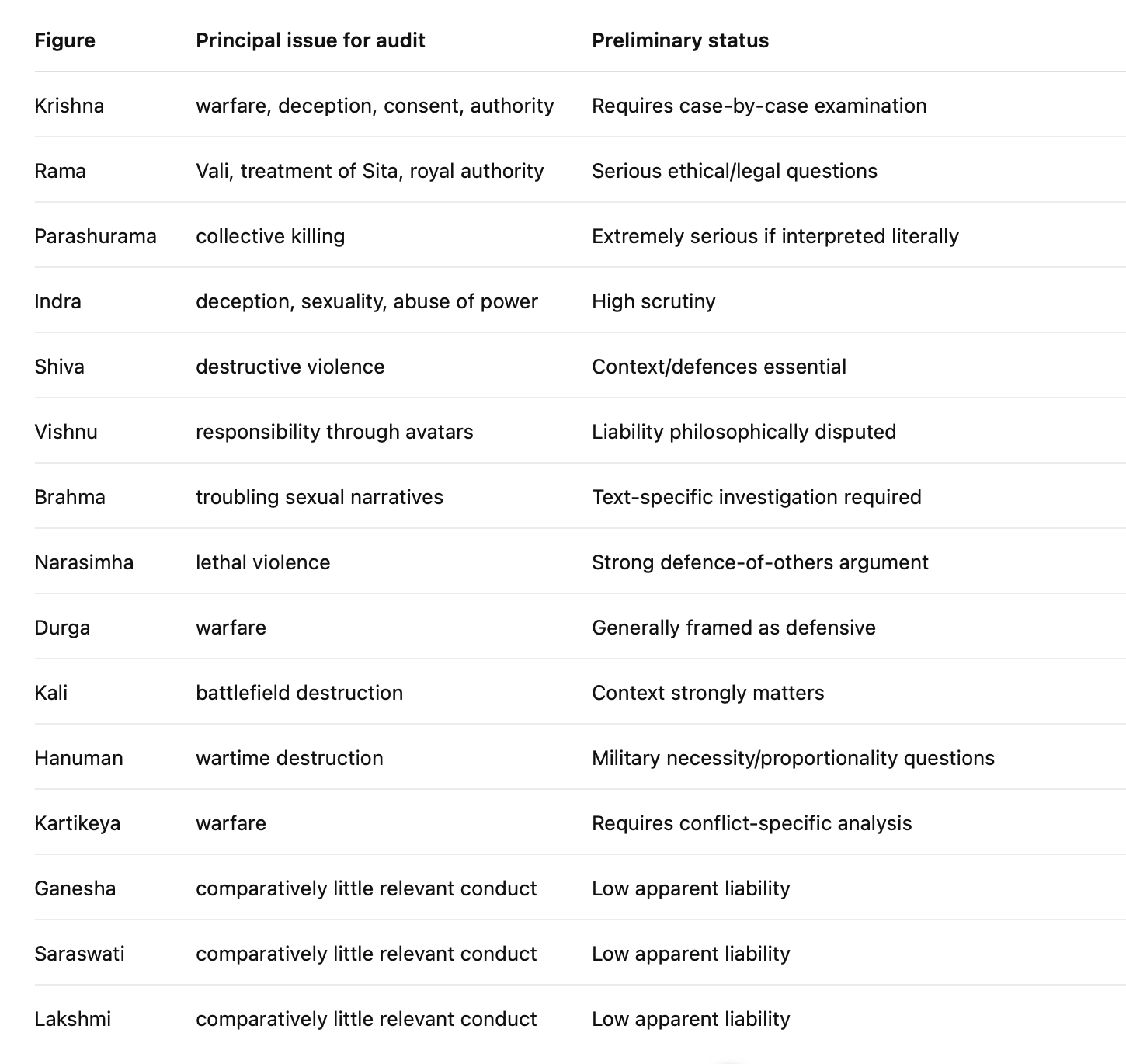
The purpose of the table is precisely not to produce a predetermined conviction.
Some defendants might be condemned.
Some might be acquitted.
Some cases would be dismissed for lack of evidence.
That is what genuine justice looks like.
XIV. The Most Radical Rule: God Can Be Acquitted
Religious criticism becomes intellectually dishonest if its purpose is simply to reverse religious apologetics.
Apologetics says:
God must always be innocent.
Anti-religious dogmatism can make the opposite mistake:
God must always be guilty.
A Tribunal should accept neither.
The standard should be:
Follow the evidence and argument wherever they lead.
If Narasimha acted legitimately in defence of Prahlada within the assumptions of the narrative, acquit him.
If another deity violated someone’s autonomy without adequate justification, condemn the conduct.
If evidence is contradictory, return no verdict.
If a story is plainly metaphorical, analyse the metaphor rather than pretending a historical crime occurred.
Justice requires the possibility of acquittal.
XV. Human Birth Means Human Rights Apply Too
There is another side to the principle.
If a god becomes human, the deity would acquire human protections as well as human responsibilities.
An avatar could not be tortured merely for being divine.
An avatar would possess freedom of expression.
An avatar would deserve due process.
An avatar could defend themselves.
An avatar could refuse worship.
An avatar could be falsely accused.
An avatar would remain innocent until wrongdoing were adequately established.
That symmetry matters.
Accountability without rights becomes persecution.
Rights without accountability become privilege.
Justice requires both.
XVI. No More Divine Diplomatic Immunity
The central conclusion is straightforward.
If Krishna takes human form, human consent applies.
If Rama rules a human kingdom, standards of political responsibility apply.
If Parashurama kills human beings, the justification for those killings can be examined.
If Indra interacts sexually with humans, human standards concerning consent and deception apply.
If Shiva uses violence affecting humans, necessity and proportionality can be examined.
If an avatar enters history, history may interrogate the avatar.
The statement:
“But he is God”
is not a defence.
At most, it is a theological claim about the identity of the defendant.
It tells us nothing about whether the defendant’s particular action was right.
XVII. The Mahakali Tribunal Principle
We can therefore formulate a constitutional principle for religion:
HUMAN INCARNATION ACCOUNTABILITY CLAUSE
Any being claiming human incarnation, embodiment or physical intervention within human society becomes subject, for purposes of human judgment, to the same fundamental standards of consent, dignity, proportionality, responsibility and justice applicable to human actors. Claimed divinity shall neither establish guilt nor confer immunity.
This principle does not require atheism.
A believer can accept it.
An agnostic can accept it.
An atheist can accept it.
Even a deity worthy of the title should have little reason to object.
Because if a god is truly just, justice will not threaten that god.
And if scrutiny destroys our conception of a god, perhaps scrutiny was never the problem.
Perhaps immunity was.
Conclusion: Put the Actions on Trial, Not Faith
Mahakali Tribunal does not need to prosecute Hinduism.
Nor does it need to prosecute Hindus.
It does not even need to begin by declaring gods guilty.
It needs something far more disruptive:
equal moral jurisdiction.
No caste immunity.
No royal immunity.
No priestly immunity.
No guru immunity.
No scriptural immunity.
No avatar immunity.
No divine immunity.
Investigate the allegation.
Examine the text.
Identify the action.
Hear the defence.
Apply consent.
Apply proportionality.
Apply equal dignity.
Then reach the verdict.
Some gods may survive the audit comfortably.
Some may require reinterpretation.
Some mythological actions may deserve explicit moral rejection.
And some allegations may collapse under examination.
That is acceptable.
Because the objective of justice is not to defeat God.
The objective is to establish a civilisation in which nobody—not even someone humanity calls God—is placed above the moral worth of the human being standing before them.